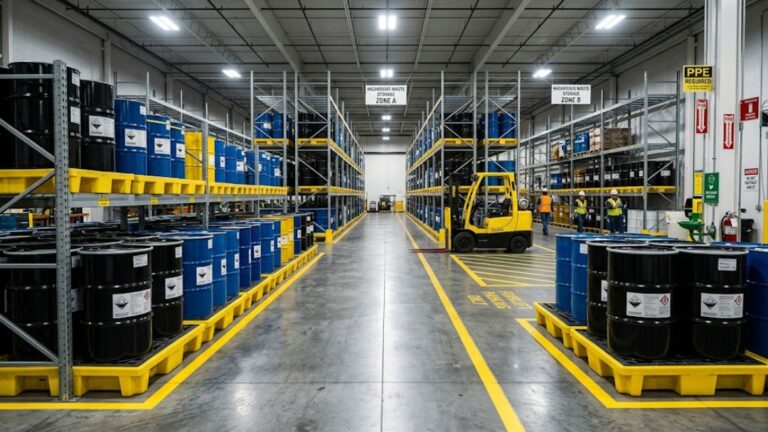
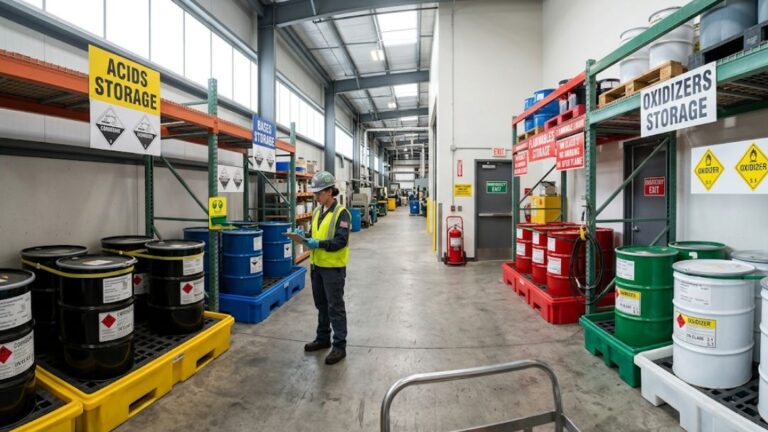
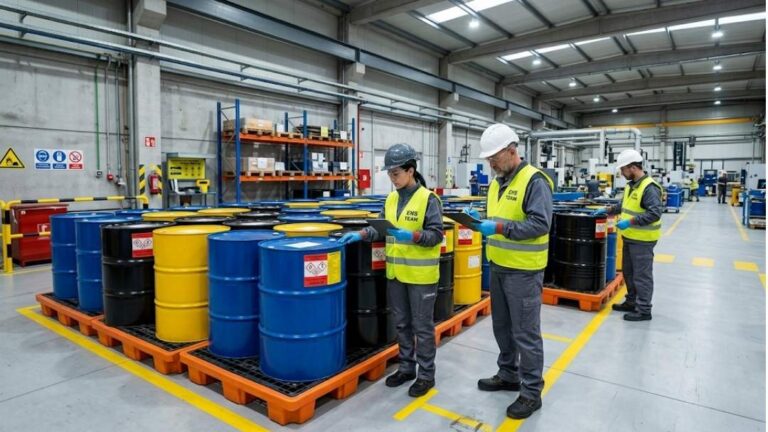
Hazardous waste drum labeling requirements under RCRA and 40 CFR Part 262 apply to every generator accumulating hazardous waste on site.
Every container must carry the words “Hazardous Waste,” an indication of the specific hazard class, and an accumulation start date when applicable.
EPA waste codes are required before off-site shipment, not at the point of generation. DOT transportation labels do not satisfy RCRA labeling rules.
Labeling deficiencies are among the most cited violations during EPA inspections, and fines under RCRA Section 3008(g) reach $93,058 per day, per violation as of January 8, 2025.
What Are the Hazardous Waste Drum Labeling Requirements?
Most facilities assume that writing “Hazardous Waste” on a drum is enough. It is not.
Inspectors look for the specific hazard indication, a legible description of the waste contents, and depending on the accumulation stage, a start date and applicable EPA waste codes.
Under 40 CFR Part 262, every container used to accumulate RCRA hazardous waste on site must be clearly marked before waste is added. This is not a step that gets completed at the end of the accumulation period.
| Required Element | What It Means | When Required | Common Error |
| “Hazardous Waste” marking | Identifies the container as regulated waste | At all times during accumulation | Missing entirely or written on tape that falls off |
| Hazard class indication | States the specific hazard (e.g., ignitable, corrosive) | At all times under 2016 HWGIR | Omitted when “Hazardous Waste” is written |
| Waste description | Describes the content (e.g., spent solvent waste) | At all times | Generic terms like “chemical waste” |
| Accumulation start date | Records when accumulation began | When SAA quantity limit is exceeded | Left blank until waste is full |
| EPA waste codes | Identifies regulatory classification codes | Before off-site shipment only | Added too early or skipped entirely |
The core legal basis comes from the EPA Hazardous Waste Generator Improvement Rule (HWGIR), finalized in 2016, which added an explicit requirement for hazard identification on all accumulation containers.
Before that rule, some generators included the hazard indication only for transport.
What Must Appear on Every Hazardous Waste Drum Label?
At a minimum, every hazardous waste drum must show:
- The words “Hazardous Waste,” clearly visible and legible
- The specific hazard class of the contents (ignitable, corrosive, reactive, toxic, or a combination)
- A plain-language description of the waste stream (for example: “spent solvent waste, ignitable”)
- An accumulation start date when the container has reached or exceeded the applicable quantity threshold
A compliant label example looks like this: Hazardous Waste | Ignitable | Spent solvent waste | Accumulation start date: [date]
| Label Category | Required | Optional but Recommended |
| “Hazardous Waste” | Yes | N/A |
| Hazard class | Yes | N/A |
| Waste description | Yes | Include chemical names where practical |
| Accumulation start date | Conditional | Best practice to add from day one |
| Generator name and address | Before shipment | Helpful at the CAA stage |
| EPA waste codes | Before shipment | Can be pre-printed on drum labels |
When Does the Label Have to Be Applied?
The label must go on the container before waste is first added. This is not a rule that applies once the drum is full or scheduled for pickup.
| Stage | Label Requirement | Action Required |
| Waste generation | “Hazardous Waste” + hazard indication | Apply before first addition of waste |
| Active accumulation (SAA) | All core elements visible and legible | Verify at each addition |
| Quantity limit exceeded | Add accumulation start date | Date the container that day |
| Transfer to CAA | Confirm all elements still legible | Re-label if damaged |
| Pre-shipment | Add EPA waste codes + generator info | Complete before transport |
EPA vs. DOT Labeling Rules: What Is the Difference?
This is one of the most common points of confusion in hazardous waste drum labeling requirements. EPA and DOT regulate the same drum at different points in its life cycle, and they require different things.
EPA RCRA labeling governs what appears on the drum while it sits on site, from the point of waste generation through the central accumulation area. DOT regulates what the drum must show during transport, once it leaves the facility.
| Requirement | EPA (RCRA) | DOT (Transportation) |
| Governing regulation | 40 CFR Part 262 | 49 CFR Parts 172-180 |
| Applies when | On-site accumulation | During off-site transport |
| Required marking | “Hazardous Waste” + hazard indication | Proper shipping name + ID number + hazard class label |
| Waste codes required | Before off-site shipment | Not the same as RCRA codes |
| Primary purpose | Hazard communication, waste tracking | Transport safety and emergency response |
Why a DOT Class 9 Label Is Not Enough
A DOT Class 9 miscellaneous label tells a carrier that the material presents a hazard during transport.
It says nothing about the specific RCRA classification of the waste, the on-site accumulation period, or the hazard characteristics that workers at the generating facility need to understand.
From an engineering perspective, these two label systems serve entirely different risk communication goals. One is for the road. The other is for the floor.
| Label Type | Compliant for Transport | Compliant for RCRA Accumulation |
| DOT Class 9 only | Yes | No |
| RCRA label only | No | Yes |
| Both applied correctly | Yes | Yes |
When Do EPA Waste Codes Need to Be Added?
EPA waste codes identify which regulatory category applies to the waste stream, such as F001 for spent halogenated solvents or D001 for ignitable waste. These codes are not required during on-site accumulation.
They must appear on the container before it moves off site to a treatment, storage, and disposal facility (TSDF) or licensed transporter. Many facilities include the codes on pre-printed labels to avoid gaps at the pre-shipment stage.
Pre-shipment label checklist:
- “Hazardous Waste” marking still visible and legible
- Hazard class indication confirmed
- Waste description present
- Accumulation start date recorded
- EPA waste codes added
- Generator name, address, and EPA ID number included
- Container integrity confirmed (no leaks, corrosion, or damage)
How to Label Drums in Common Facility Scenarios
Hazardous waste drum labeling requirements apply the same way in theory, but in practice the physical setup of each facility changes how labels get placed, maintained, and verified.
| Scenario | Label Timing | Special Considerations |
| Satellite accumulation area | Before first waste addition | Hazard indication required from day one |
| Central accumulation area | Upon transfer from SAA | Confirm all elements are legible; add date if not already present |
| Pre-shipment staging | Before transporter pickup | Add EPA codes, generator info |
| Academic or lab settings | Per container, at the bench level | Labels may be “associated with” the container, not only affixed |
Satellite Accumulation Area Labeling
Satellite accumulation area requirements under 40 CFR §262.15 allow generators to hold up to 55 gallons of non-acute hazardous waste at or near the point of generation without a RCRA permit. Each container in that area must carry the full label from day one.
The accumulation start date is required on the container the day the quantity limit is crossed, not when the container is full.
SAA label checklist:
- “Hazardous Waste” written clearly on the container
- Hazard class stated (ignitable, corrosive, reactive, toxic)
- Waste stream described in plain language
- Date added when quantity threshold is exceeded
- Container kept closed except when adding waste
Central Accumulation and Staging Drums
Once waste moves from an SAA to the central accumulation area, the labeling requirements become more formal. The container needs all core elements, and the accumulation start date becomes critical for tracking the CAA clock.
| Stage | What Changes on the Label | What Stays the Same |
| Arrival at CAA | Confirm or add start date | All core elements remain required |
| During CAA storage | No changes required unless damage occurs | Labels must stay legible throughout |
| Pre-shipment | Add EPA waste codes + generator info | Hazard indication and description still required |
For facilities that use waste compactors to reduce drum volume before CAA storage, the compacted waste containers must carry the same complete label as any other accumulation drum. Volume reduction does not change the labeling obligation.
Common Labeling Mistakes That Trigger Compliance Problems
Inspectors follow the same checklist on every visit. The violations that come up most often are not complex, but they are consistent.
| Mistake | Why It Matters | How to Fix It |
| Missing hazard indication | Violates 2016 HWGIR directly; one of the most cited deficiencies | Add the specific hazard class alongside “Hazardous Waste” |
| Vague waste description | Makes waste identification difficult for handlers and emergency responders | Use descriptive language: “spent chlorinated solvent, ignitable” instead of “waste solvent” |
| Label applied after drum is full | Creates a window where the container is unidentified and uncontrolled | Apply label before first addition |
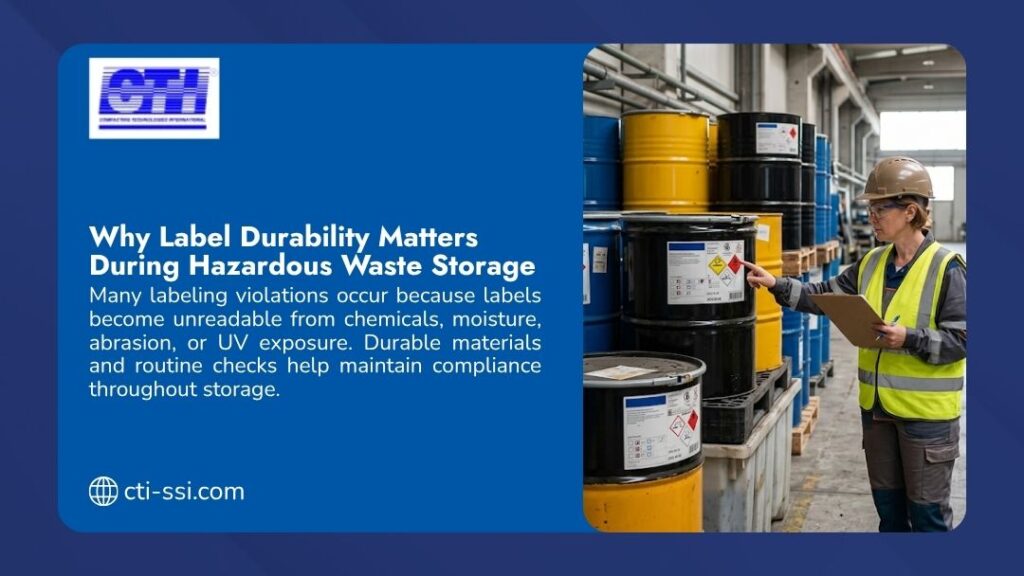
| Faded or damaged labels | Unreadable labels carry the same legal exposure as missing ones | Use chemical-resistant label materials; inspect at every drum check |
| Unknown or legacy drums | Triggers full waste characterization, which is expensive and time-consuming | Treat as unknown hazardous waste; isolate and characterize before reuse |
Weekly drum inspection requirements cover the physical checks generators must perform at set intervals. Label legibility is part of that inspection record.
Missing or Vague Hazard Information
The hazard indication requirement under the 2016 HWGIR is one of the most frequently missed elements during compliance reviews.
A label that reads “Hazardous Waste – Used Oil” does not meet the standard if it does not state the applicable hazard class.
| Weak Label | Stronger Label |
| Hazardous Waste | Hazardous Waste, Ignitable |
| Chemical waste | Hazardous Waste, Corrosive, Spent acid solution |
| Waste solvent | Hazardous Waste, Ignitable and Toxic, Spent halogenated solvent |
Understanding the characteristics of hazardous waste, specifically ignitability, corrosivity, reactivity, and toxicity, determines which hazard class belongs on the label.
A misidentified characteristic is a labeling violation and a waste determination failure at the same time.
Faded, Reused, or Unknown Waste Drums
Legacy drums and worn labels create a different kind of compliance problem. The container still holds regulated waste, but the label no longer communicates what it needs to.
What to do when a label is unreadable:
- Isolate the drum and flag it as potentially unknown or unidentified waste
- Do not attempt to add waste to the container until it is re-labeled
- Check facility manifests, waste logs, and generator records to identify the contents
- If contents cannot be confirmed, treat the drum as unknown hazardous waste and initiate characterization
- Re-label with all required elements before returning the container to active accumulation
| Problem | Regulatory Risk | Recommended Action |
| Label faded but contents known | Low to moderate; still a deficiency | Re-label immediately with full information |
| Label missing, contents unknown | High; waste determination failure | Isolate, characterize, re-label before further use |
| Reused drum with old label remaining | Moderate to high | Remove or cover old label entirely; apply new compliant label |
A Simple Drum Labeling Workflow Your Team Can Follow
Hazardous waste drum labeling requirements are easier to maintain when the process is standardized across the facility, not left to individual judgment at the point of generation.
| Step | Owner | Timing | Verification |
| 1. Identify the waste stream | Waste generator / process operator | Before first addition | Confirm hazard characteristics |
| 2. Select appropriate container | EHS coordinator | Before first addition | Check compatibility with waste type |
| 3. Apply core label elements | Waste generator | Before first addition | “Hazardous Waste” + hazard class + description |
| 4. Confirm SAA quantity | EHS coordinator or supervisor | Each addition | Check against 55-gallon threshold |
| 5. Add start date when threshold is crossed | Waste generator | Day threshold is exceeded | Date must be recorded that day |
| 6. Transfer to CAA when required | Facility staff | Within 3 calendar days of overage | Confirm label is complete and legible |
| 7. Add EPA waste codes before shipment | EHS coordinator | Pre-shipment | Cross-check against waste profile |
| 8. Final label verification | EHS coordinator | Day of pickup | All elements present, legible, and accurate |
Step-by-Step Labeling Checklist
Before any drum leaves the satellite accumulation area or enters the pre-shipment stage, run through this sequence:
- Confirm waste type and applicable hazard characteristics
- Verify “Hazardous Waste” is written or printed clearly on the container
- Confirm hazard class is stated (ignitable, corrosive, reactive, toxic, or combination)
- Confirm waste description is specific and accurate
- Check that the accumulation start date is recorded if the quantity limit was exceeded
- Verify the label is chemically resistant and fully legible
- Add EPA waste codes before any off-site movement
- Include generator name, address, and EPA ID number for transport
Secondary containment requirements for drums apply at the CAA stage once drums are staged for storage. Verifying containment integrity as part of the pre-shipment review reduces the risk of a secondary compliance gap.
How to Train Staff to Label Drums Correctly
Most labeling violations are not intentional. They result from unclear procedures, missing materials, or workers who simply do not know what a compliant label looks like.
| Role | Training Focus | Frequency |
| Waste generators (floor staff) | Hazard identification, label elements, timing | Onboarding + annual refresher |
| EHS coordinator | Regulatory updates, inspection readiness, SAA management | Ongoing + after any inspection finding |
| Supervisors | Audit checklist review, staff compliance checks | Quarterly |
Practical steps that reduce labeling errors:
- Post a laminated label example at each SAA location
- Pre-print labels with “Hazardous Waste” and hazard class fields already included
- Conduct periodic unannounced walkthroughs to check label completeness
- Include label audits in the weekly drum inspection log
FAQs About Hazardous Waste Drum Labeling Requirements
What information is required on a hazardous waste drum label?
Every container must be marked with the words “Hazardous Waste,” the specific hazard class of its contents, and a plain-language description of the waste.
An accumulation start date is required when the container exceeds the applicable quantity threshold. EPA waste codes and generator information must be added before the drum moves off site.
Do hazardous waste drums need the accumulation start date?
The accumulation start date is required on a container the day it exceeds the SAA quantity limit, either 55 gallons for non-acute hazardous waste or 1 quart for liquid acute hazardous waste.
Many facilities apply the date from day one as a best practice, which removes ambiguity during inspections.
Is a DOT Class 9 label enough for hazardous waste drums?
No. A DOT Class 9 label satisfies transportation marking requirements under 49 CFR, but it does not meet EPA RCRA labeling standards for on-site accumulation. Generators must maintain both sets of labels when a drum is prepared for off-site shipment.
When do EPA waste codes need to be added?
EPA waste codes are not required during on-site accumulation. They must appear on the container before it leaves the facility for transport to a licensed TSDF or off-site disposal facility.
Can I use a preprinted hazardous waste label?
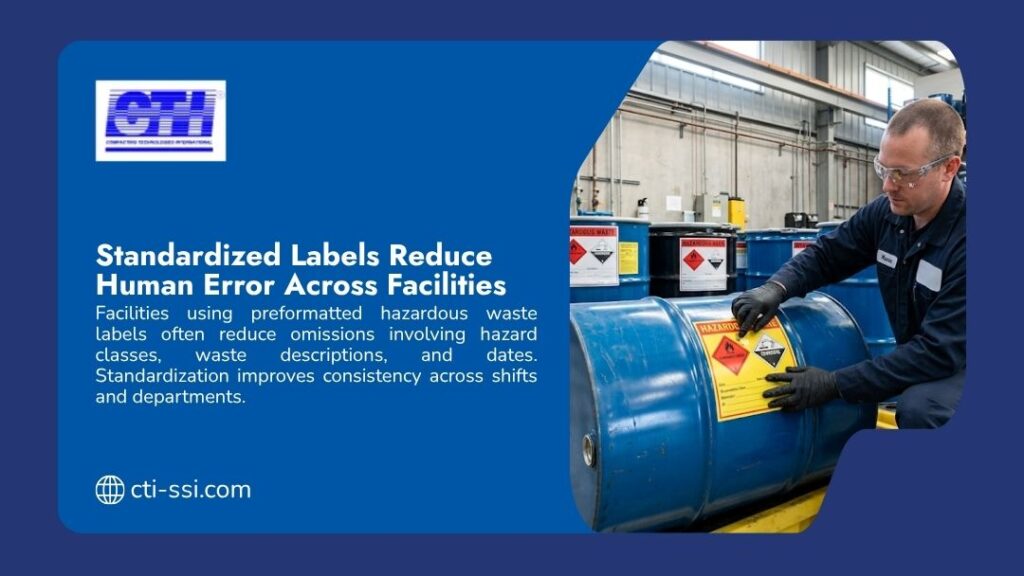
Pre-printed labels that include all required fields are acceptable under RCRA as long as every element is completed accurately and the label remains legible throughout the accumulation period.
Pre-printed labels with fields for the hazard class and waste description reduce the chance of omission errors at the point of generation.
CTI Safety Storage: Compaction Systems for Hazardous Waste Compliance
Correct labeling keeps a facility compliant on paper. Reducing the total number of active drums reduces the number of open compliance points at any given time.
CTI Safety Storage designs and manufactures industrial waste compactors for hazardous, low-level radioactive, and specialized solid waste streams.
With up to 60,000 lbs of compaction force, CTI systems reduce drum count across both satellite and central accumulation areas, which directly lowers the number of labels to maintain, inspection points to track, and transfer deadlines to monitor.
CTI compactor features for compliance-sensitive applications:
- HEPA filtration at 99.97% efficiency, rated to 0.3 microns, for particulate-laden and radioactive waste
- NEMA 7 explosion-proof components for classified hazardous environments
- Stainless steel platens and chambers for corrosive or decontamination-grade applications
- Liquid removal systems rated for solvent and chemical residues
- Two-stage hydraulic systems with safety interlocks and programmable logic controllers
- Fire suppression fittings for high-risk compaction scenarios
Fewer active drums mean fewer open labeling obligations, fewer SAA quantity thresholds in motion, and less compliance exposure at every stage of the waste cycle.
Contact CTI Safety Storage to request a quote or discuss a compaction solution matched to your waste stream, facility layout, and hazardous waste drum labeling requirements.