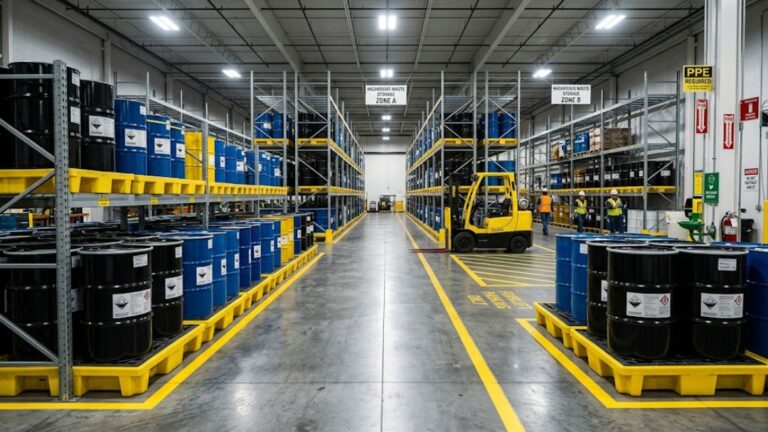
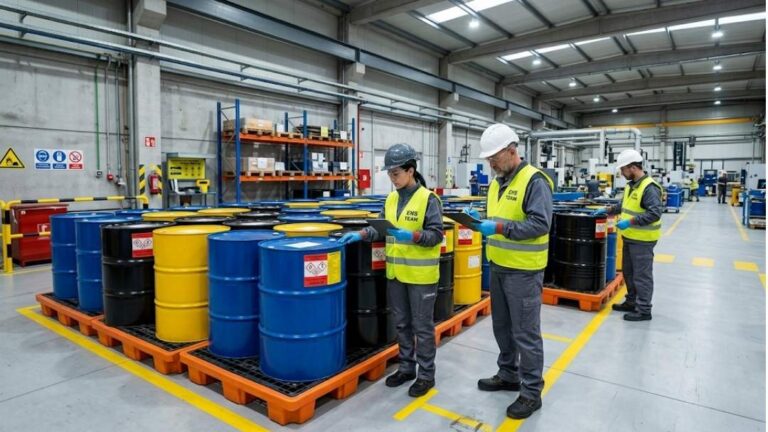
Article Summary
- Incompatible waste storage requirements under RCRA prohibit co-location of hazardous waste streams that can produce heat, fire, explosion, or toxic gas on contact
- The official EPA definition under 40 CFR Part 260 covers both shared containers and the reuse of unwashed containers that previously held incompatible material
- As of January 8, 2025, EPA civil penalties for RCRA violations reach up to $93,058 per day, per violation
- Improperly managed containers are among the most frequently cited violations in EPA enforcement actions across the U.S.
- Separation methods include dedicated containers, secondary containment per hazard group, cabinet segregation, and clearly labeled storage zones
Most facilities do not discover a storage problem until an inspector arrives, or until a near-miss forces the issue. Incompatible waste storage requirements exist to prevent that outcome.
Under RCRA hazardous waste law, two core prohibitions define the baseline: reactive waste streams cannot share the same container, and waste cannot go into an unwashed container that previously held an incompatible material.
What Are Incompatible Waste Storage Requirements?
The federal definition comes from 40 CFR Part 260.
Under that regulation, “incompatible waste” describes hazardous material unsuitable for commingling with another waste or material because the combination could produce heat or pressure, fire or explosion, toxic dusts, flammable fumes or gases.
These incompatible waste storage requirements cover not just the waste itself, but the full storage environment: the container, prior contents, and all nearby materials.
| Rule Point | What It Means | Why It Matters |
| No commingling of incompatible wastes | Reactive waste streams cannot share one container | Reaction risk: heat, pressure, toxic gas, fire |
| No unwashed container reuse | Containers from prior incompatible waste must be cleaned before reuse | Residue contact triggers the same reactions as direct co-mingling |
| Storage context matters | Nearby materials affect the overall risk profile | Proximity to incompatibles creates risk even across separate containers |
What Does “Incompatible” Mean in Waste Storage?
The term carries a precise regulatory meaning. Two waste streams are incompatible when their combination, under uncontrolled conditions, produces a hazardous outcome.
A common example: acid waste and base waste placed in the same container generate enough heat and pressure to breach the drum. The chemistry starts the reaction. The storage setup is where the damage actually occurs.
Which Wastes and Storage Situations Create the Biggest Risk?
A study published in the Annals of Emergency Medicine tracked 102,177 hazardous chemical incidents across the U.S. from 2021 to 2024, with total damages exceeding $1 billion.
Chemical transportation and storage accounted for 8.6% of those incidents. The pattern across EHS enforcement data follows the same shape: storage failures are predictable, not anomalous.
Per Lab Manager Magazine, improper storage of chemicals accounts for roughly 25% of all chemical accidents in laboratories.
The two categories responsible for the majority of incompatible waste storage requirements violations in industrial settings are routine, high-frequency pairings that were never reviewed for hazard compatibility.
What Kinds of Waste Are Most Often Stored Apart?
The broadest incompatibility groups that appear across EHS guidance and regulatory appendices include:
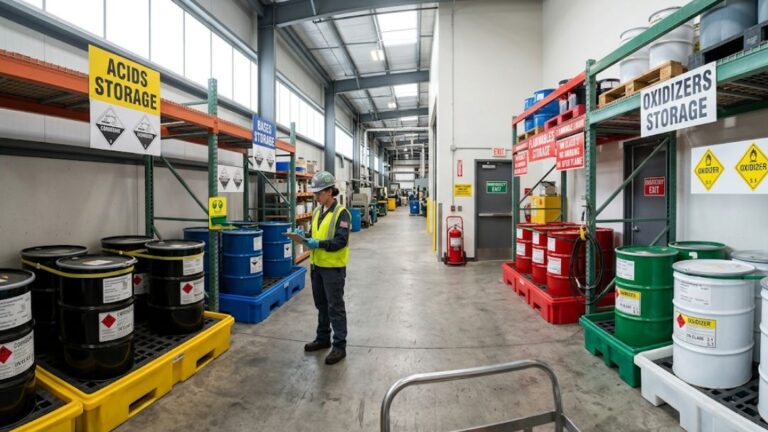
- Acids and bases: exothermic reaction on contact, corrosive and toxic byproducts
- Oxidizers and combustibles: fire and explosion risk under standard storage conditions
- Reactive wastes (water-reactive or pyrophoric): self-ignition or explosion on contact with air or water
- Corrosive wastes near flammable containers: progressive degradation of container integrity over time
For storage areas with flammable waste streams, flammable cabinet requirements establish the physical separation standards that apply at the cabinet and room level.
| Common Storage Pairing | Main Hazard | Safer Approach |
| Acids + Bases | Exothermic reaction, toxic gas | Separate containers, separate secondary containment |
| Oxidizers + Combustibles | Fire, explosion | Different storage zones or separate cabinets |
| Corrosive + Reactive metals | Violent reaction | Physical barrier or separate room |
| Flammable liquids + Incompatible oxidizers | Fire risk | Flammable-rated cabinet, clear hazard labels |
Why Alphabetical Storage Can Create Hidden Risk
Alphabetical order is a common default in lab and chemical room layouts. The problem is that the alphabetical sequence ignores hazard class entirely.
Acetone (flammable) and ammonium nitrate (oxidizer) are adjacent alphabetically. On a storage shelf, that proximity creates a fire risk with no separation control in place.
The same logic applies to waste containers. A neat, labeled shelf can still represent a compliance failure if the hazard classes of adjacent containers were never reviewed before placement.
| Storage Method | Hazard Class Awareness | Compliance Risk |
| Alphabetical | None | High, hazard class ignored |
| Organized by hazard class | Full | Low when properly labeled |
| By waste stream with SDS review | Comprehensive | Lowest, with a documented decision trail |
How to Separate Incompatible Waste in Practice
Incompatible waste storage requirements do not prescribe a single physical method. They require that incompatible materials cannot contact each other under foreseeable conditions.
What that looks like on the floor depends on the waste streams present and the layout of the accumulation area.
Core separation methods in active use include:
- Separate containers within the same secondary containment tray, for low-risk pairings where the tray material is compatible with both streams
- Dedicated containment trays per hazard group, for reactive or corrosive streams where shared containment creates cross-contamination risk
- Physical barriers between storage zones, for oxidizer and flammable pairings that require spatial separation
- Separate cabinets or rooms for the highest-hazard combinations where proximity alone is unacceptable
For drum-based storage at the accumulation stage, secondary containment requirements for drums cover the containment volume, material compatibility, and inspection standards that apply to each storage unit.
| Separation Method | Best Use Case | What It Prevents |
| Separate containers, shared tray | Low-hazard pairings with a compatible tray | Accidental co-mingling |
| Dedicated tray per hazard group | Corrosive or reactive waste streams | Cross-contamination from container failure |
| Physical barrier | Oxidizer and combustible storage | Contact during a spill event |
| Separate cabinet or room | Highest-hazard combinations | Simultaneous exposure |
Secondary Containment, Cabinets, and Barriers
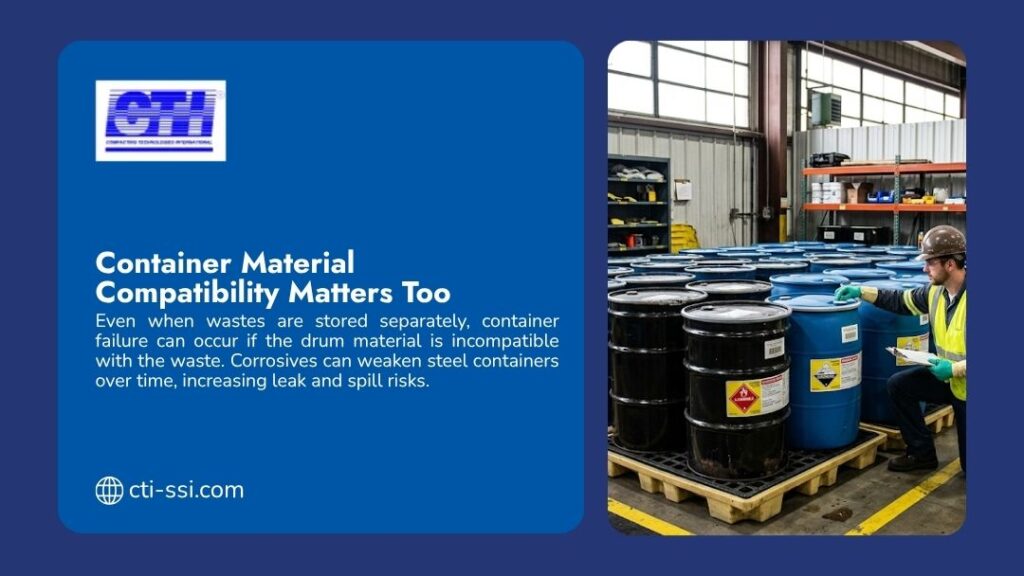
Secondary containment provides a critical backup layer, but it does not replace physical separation for incompatible streams. Two waste streams in different containers but in the same containment tray remain at risk if either container fails.
The tray material must be compatible with both waste types, and its volume must accommodate the full contents of the largest container.
Cabinet separation applies when different hazard classes cannot safely share containment space. Corrosive and flammable waste streams require different cabinet specifications, different liner materials, and different inspection intervals.
How to Document the Segregation Decision
Compliance documentation should answer three questions: what was stored, where it was stored, and why that location was selected. A pre-placement checklist covers the baseline for most accumulation areas.
Pre-placement checklist:
- Waste type and hazard class confirmed
- Prior container contents verified (no incompatible residue present)
- Segregation method selected: container, tray, or cabinet
- Storage location recorded in the site inventory
- Compatibility verified before placement, signed off by the responsible operator
Common Mistakes That Lead to Compliance Problems
In EPA enforcement actions, the pattern is consistent. Most RCRA violations are not the result of unusual events. They come from operational gaps that build over time.
Improperly managed containers are one of the most frequently cited RCRA violations. The majority of fines go toward administrative and operational failures: a drum without an accumulation date, an open container, a container reused without verification of prior contents.
A January 2026 EPA enforcement action against a Louisiana facility found approximately 250 damaged containers, more than 200 spills, and more than 300 unlabeled or unidentified containers, all tied to hazardous waste storage failures.
| Mistake | Risk | Better Practice |
| One container for multiple waste types | Incompatible reaction inside the drum | One hazard class per container, consistently |
| Reuse of an unwashed container | Residue contact with the new waste stream | Verify prior contents and clean before reuse |
| Labels with no hazard class | Inspection failure, misclassification | Include hazard type on every label |
| Skipped secondary containment | Uncontrolled spill with no backup control | Use compatible containment per waste group |
| Application of chemical rules to waste storage | Wrong segregation method for the waste type | Review RCRA requirements for each waste stream |
For current label content standards and an audit-ready format, hazardous waste drum labeling requirements outline what EPA inspectors check first during a site visit.
The “Looks Organized” Trap
A facility can have clean shelves, consistent labels, and clear aisle access and still fail a compatibility review. Organizational neatness does not equal compatibility logic.
Two well-labeled containers placed next to each other remain a violation if their waste streams are incompatible and no separation method is in place.
When Waste Rules and Chemical Rules Get Confused
| Stored Material | Applicable Rules | Key Difference |
| Unused chemical (pre-use inventory) | OSHA HazCom, site SOP | Not subject to RCRA waste regulations |
| Hazardous waste | RCRA, 40 CFR Parts 262-265 | Generator status and accumulation limits apply |
| Expired or discarded chemical | RCRA if characteristic or listed | Disposal rules apply from the point of discard |
The distinction matters in practice. Applying pre-use chemical storage rules to hazardous waste containers produces storage decisions that look correct but fail under RCRA review.
The container may look identical, but the regulatory classification determines whether the setup holds up.
A Simple Compatibility Review Process for Facilities
The most reliable way to prevent incompatible waste storage problems is a repeatable pre-placement process applied every time a waste stream enters the accumulation area.
This does not require a specialist for each transfer. It requires a documented checklist and a clear sign-off chain.
What to Check Before Storage
| Step | What to Check | Who Signs Off |
| 1. Identify the waste | Type, hazard class, characteristic | Generator or EHS staff |
| 2. Review prior container use | Prior contents, residue status, compatibility | Responsible operator |
| 3. Confirm the segregation method | Container, tray, or cabinet selection | EHS or facility manager |
| 4. Verify the storage location | Compatible neighbors, labels in place | Site supervisor |
| 5. Document the decision | Record in site inventory, signed and dated | EHS manager |
What to Do When the Storage Area Is Already Messy
Inherited or disorganized accumulation areas are a common starting point. A triage process helps identify what needs immediate action without creating additional risk during the reset.
| Priority Level | Condition | Recommended Action |
| Urgent | Incompatible wastes in the same container or tray | Separate immediately, assess for reaction |
| Needs Review | Unknown contents, no label, no documentation | Identify the waste before any transfer |
| Acceptable | Properly labeled, segregated, compatible containment | Log and continue the normal accumulation cycle |
What Counts as Incompatible Waste Storage Requirements in a Real Facility?
In practice, incompatible waste storage requirements come down to three conditions:
- No shared containers between reactive waste streams,
- No reuse of unwashed containers that previously held incompatible materials
- Physical separation appropriate to the hazard class of each stream.
As of November 2025, over 592,000 facilities across the U.S. generate regulated hazardous waste, per EPA e-Manifest system data. At that scale, the compatibility review is not a one-time setup.
It becomes a permanent operational discipline with financial stakes that rise each day a gap remains unaddressed.
Frequently Asked Questions
1. What are incompatible waste storage requirements?
Under RCRA and 40 CFR Part 260, incompatible waste storage requirements prohibit the placement of waste streams together when their combination could produce heat, pressure, fire, explosion, violent reaction, or toxic gas.
The rules also prohibit waste placement into a container that previously held an incompatible material without first cleaning that container.
2. Can incompatible wastes be stored in the same container?
No. Federal RCRA regulations prohibit the co-mingling of waste streams that react with each other or with the container material. One hazard class per container is the standard in compliant accumulation areas.
3. Does the rule apply to unwashed containers?
Yes, an unwashed container that previously held incompatible waste creates the same regulatory hazard as direct co-mingling. Prior residue can react with the new waste stream even when the residue volume is small.
4. Is secondary containment enough on its own?
Secondary containment is a necessary backup layer, but it does not replace physical separation for incompatible streams.
Two waste streams in different containers but in the same tray remain at risk through a container failure event. The tray material must also be compatible with all waste types present.
5. How do I know if two wastes are incompatible?
Start with the Safety Data Sheet for each waste stream. Review the reactivity section and the incompatibility notes. Cross-reference against EPA Appendix V of 40 CFR Parts 264 and 265, which lists common incompatible waste pairings.
For complex or mixed streams, site EHS staff or a licensed waste consultant should review the combination before placement.
CTI Safety Storage: Compaction Equipment for Hazardous Waste Compliance
Incompatible waste storage problems often start with volume. More active containers mean more containers to segregate, label, and inspect.
A reduction in total active waste volume directly reduces the number of containers at risk of incompatibility violations at any point in the accumulation cycle.
CTI Safety Storage designs and manufactures industrial waste compactors for hazardous, low-level radioactive, and specialized solid waste streams. Three core models cover a range of force output levels and safety specifications:
| Model | Compaction Force | Key Safety Features |
| CTI 8040 | Standard range | Two-stage hydraulic system, PLC controls, safety interlocks |
| CTI 8550 | 60,000 lbs | NEMA 7 explosion-proof components, drum crush package, inert gas purge |
| CTI 8560 | 60,000 lbs | HEPA filtration at 99.97% to 0.3 microns, stainless steel platen, VOC/carbon filtration |
Optional configurations for compliance-sensitive applications include:
- NEMA 7 explosion-proof components for classified hazardous environments
- Liquid removal systems for solvent and chemical residue streams
- Fire suppression fittings for high-risk compaction scenarios
- Stainless steel platens and chambers for corrosive or radioactive decontamination
From an engineering perspective, the compliance value of compaction is direct: fewer active containers means fewer segregation points to monitor, fewer labels to maintain, and fewer accumulation thresholds in active rotation.
Contact CTI Safety Storage to request a quote or discuss a compaction solution matched to your waste stream, facility layout, and incompatible waste storage requirements.