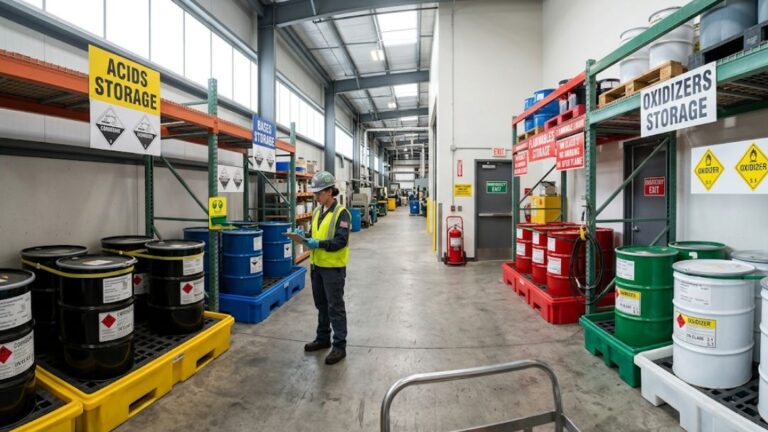
Article Summary
- Drum storage aisle spacing requirements under 40 CFR §265.35 specify no fixed dimension; compliance is access-based and performance-driven
- The EPA rule requires aisles to allow unobstructed movement of personnel, fire protection equipment, spill control equipment, and decontamination equipment in an emergency
- OSHA sets no universal fixed width for drum storage; a 1972 interpretation letter suggested 4 feet but was later withdrawn and is not an enforceable standard
- State-authorized programs may impose specific minimums; New Jersey requires 18 inches of aisle space for single-stacked 55-gallon drums
- Most inspection failures trace back to blocked access, not mismeasured aisles
One crowded aisle in a drum storage area can trigger a compliance violation, but the rules behind drum storage aisle spacing requirements are often misunderstood.
Under 40 CFR §265.35 and osha drum storage requirements, no single universal aisle width applies to every facility.
Compliance is determined by access quality, emergency response capability, and how an inspector evaluates the entire storage area on a given day.
Drum Storage Aisle Spacing Requirements in Real Facilities
The most common misconception about drum storage aisle spacing requirements is that a fixed legal dimension exists somewhere in federal law. It does not.
What exists is a functional standard: aisles must allow unobstructed movement of people and emergency equipment to every part of the storage area.
Compliance is shaped by site-specific factors rather than a fixed number.
| Factor | Impact on Spacing | Why It Matters |
| Forklift or cart use | Wider clearance required | Equipment turning radius must fit within the aisle |
| Hazard class of drum contents | Higher hazard = greater access priority | Emergency response needs faster, wider pathways |
| Facility layout and column positions | Constrains available aisle width | Physical barriers define realistic options |
| Emergency equipment location | Aisles must reach all response gear | Fire and spill response depends on clear paths |
| Drum stack configuration | Affects sightlines and movement | Stacked drums reduce visibility and access quality |
The standard holds facilities accountable for access quality, not aisle measurement. That distinction is the foundation of every compliance evaluation in regulated drum storage.
Regulatory Framework Behind Drum Storage Aisle Spacing
Why do different sources appear to give different answers about drum storage aisle spacing requirements? Multiple agencies regulate overlapping aspects of the same space.
No single source gives a universal dimension, but each contributes a layer to the overall compliance picture.
The three regulatory sources most drum storage areas encounter:
- EPA under RCRA (40 CFR §265.35): Requires aisle space to allow unobstructed movement of personnel, fire protection equipment, spill control equipment, and decontamination equipment in an emergency; no specific dimension is given
- OSHA (29 CFR 1910.176(a)): Requires sufficient safe clearances in aisles where mechanical equipment is in use; requires permanent aisles to be appropriately marked
- Fire codes (NFPA 30 and OSHA 1910.106): For indoor flammable liquid storage rooms with racks, NFPA 30 requires a 4-foot aisle between racks; OSHA 1910.106 requires at least 3-foot aisles in flammable storage rooms for access to doors, windows, and standpipe connections
| Regulatory Source | Primary Focus | Key Requirement |
| EPA (40 CFR §265.35) | Emergency access and spill response | Unobstructed movement; no fixed dimension stated |
| OSHA (29 CFR 1910.176(a)) | Worker safety and equipment clearance | Sufficient safe clearances; marked permanent aisles |
| OSHA (1910.106) | Flammable storage room access | At least 3-foot aisles to doors and window connections |
| NFPA 30 | Flammable liquid storage racks | 4-foot aisle required between storage racks |
| OSHA (1910.36(g)(2)) | Emergency exit access | 28-inch minimum width for egress routes |
Does OSHA Specify a Fixed Aisle Width for Drum Storage?
OSHA does not prescribe a universal fixed aisle width for drum storage. The general aisle standard under 29 CFR 1910.176(a) requires sufficient safe clearances but gives no specific measurement for drum storage areas.
The often-cited “4-foot rule” traces back to a May 15, 1972 OSHA Letter of Interpretation. That letter stated the recommended width of permanent aisles is at least 3 feet wider than the largest equipment used, or a minimum of 4 feet, whichever is greater.
That interpretation was subsequently withdrawn. It is not an enforceable federal standard for drum storage, though many EHS professionals still reference it as a practical benchmark.
What Inspectors Look for in Drum Storage Aisle Compliance
Most violations in drum storage areas are not caused by drum placement alone. They come from blocked access, gradual aisle erosion, and storage layouts that expanded without a compliance review.
From our direct experience with hazardous waste management equipment, inspectors evaluate access quality across the entire storage area, not just one aisle dimension. The priority list is consistent across RCRA compliance evaluations:
- Clear and unobstructed access to every drum in the storage area
- Open pathways for fire protection equipment, spill response gear, and decontamination tools
- No obstruction of emergency exits, fire extinguishers, or eye wash stations
- Ability to quickly identify and reach any container for inspection
- Sufficient visibility throughout the area for routine weekly compliance review
In one documented enforcement case, EPA charged a company with 15 violations that included lack of aisle space, improper labeling, and container management failures.
The total penalty reached $255,344. The facility had not committed one isolated error. It had accumulated a pattern of small failures over time.
| Common Inspection Failure | Violation Risk | Regulatory Reference |
| Blocked aisle from added drum rows | High | 40 CFR §265.35 |
| Emergency equipment unreachable | Critical | 40 CFR §265.30-265.37 |
| Poor waste type segregation within zones | High | 40 CFR §265.177 |
| Aisle not marked or identifiable | Medium | OSHA 29 CFR 1910.176(a) |
| Drums stacked past safe sightlines | Medium-High | 40 CFR §265.35 |
Practical Drum Storage Layout Logic for Safe Aisle Spacing
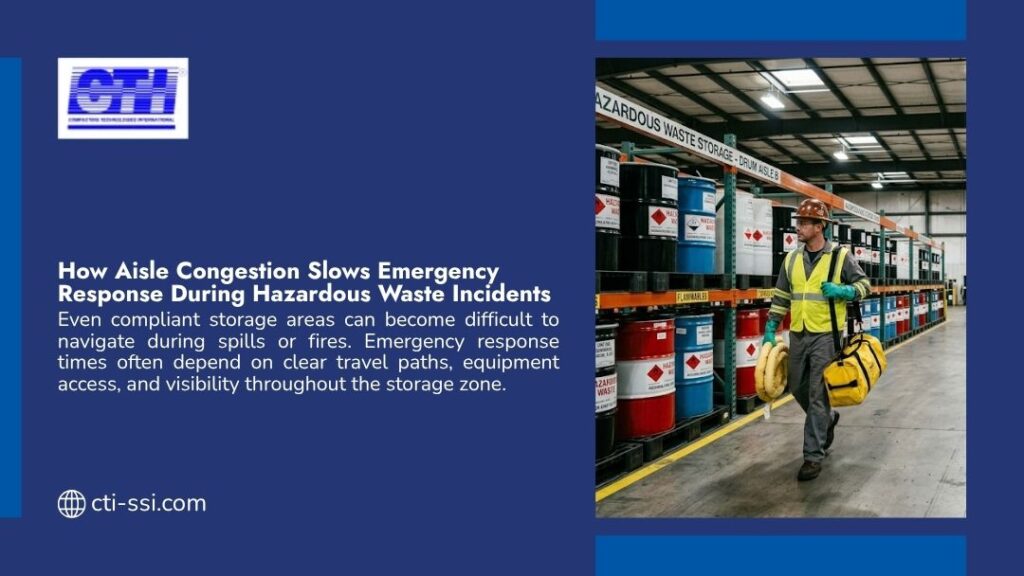
When no fixed number exists, real facilities make spacing decisions based on function. The right question is not “how many feet?” but “what does this aisle need to do?” Each aisle type in a drum storage area serves a distinct purpose. Width follows from that purpose.
| Aisle Type | Primary Purpose | Practical Clearance Logic |
| Emergency response aisle | Fire, spill, and decontamination equipment access | Wide enough for the largest on-site response equipment |
| Operational aisle (forklift) | Drum placement and retrieval by equipment | Equipment turning radius plus a safety buffer |
| Inspection access aisle | Visual access and routine compliance review | Wide enough for a person with inspection documentation |
| Pedestrian path | Staff movement between storage zones | Minimum 28 inches for egress; wider for routine traffic |
As of January 15, 2025, OSHA penalties for serious violations reach $16,550 per violation, and willful or repeated violations can reach $165,514 per violation.
Inadequate clearance for forklifts or blocked access paths can put a storage area in violation of multiple standards at the same time.
For drum-based containment setups, secondary containment requirements for drums define the containment dimensions that directly affect available aisle space within central accumulation areas.
Forklift Access vs Pedestrian Access Requirements
Aisle spacing is often determined more by equipment movement than by regulatory text. OSHA’s 29 CFR 1910.176(a) requires sufficient safe clearances for mechanical equipment but sets no universal width. The actual dimension follows from the specific equipment used on-site.
OSHA’s own forklift eTool notes that conventional rack systems for counterbalanced lift trucks generally require approximately 12 feet of aisle width. That is not a universal rule.
It reflects the turning radius and load dimensions of one specific equipment type, not a fixed standard for all drum storage areas.
Forklifts were the source of 84 work-related deaths in 2024 and 25,110 DART cases in 2023-2024, per National Safety Council data. In 2024 alone, OSHA cited 2,248 forklift-related violations with total penalties exceeding $8 million.
The manufacturing sector led to 937 violations. Narrow, congested aisles in drum storage areas are a direct contributing factor to these outcomes.
Common Mistakes in Drum Storage Aisle Design
Most drum storage aisle compliance problems begin as small design decisions that compound over time. Each one appears manageable in isolation. The cumulative pattern becomes the violation risk.
The most frequent errors in hazardous drum storage layouts:
- Gradual aisle reduction from added drum rows without a layout review
- Temporary storage placed in aisles during high-output periods that becomes permanent
- Failure to account for emergency equipment clearance at the initial layout stage
- Incompatible waste types placed in adjacent zones with no physical separation
- Drums stacked above safe height limits to compensate for lost floor space
| Mistake | Consequence | Better Practice |
| Drums added until aisle narrows | Emergency access blocked, RCRA citation | Set a maximum drum count per row at layout stage |
| Temporary storage left in aisle | Becomes a citation during inspection | Designate a separate temporary holding zone |
| Emergency equipment blocked | Response delayed, serious fine exposure | Maintain a clear radius around all response equipment |
| No aisle markings | Aisle boundaries drift over time | Mark permanent aisles with durable floor tape |
| Mixed hazard classes in same zone | Incompatibility risk, inspection failure | Segregate by hazard class from the first drum placed |
For label standards that directly affect inspector evaluation during aisle walkthroughs, hazardous waste drum labeling requirements outline what auditors check first on a site visit.
The “Looks Organized” Trap
A neat storage area is not a compliant one. Clean rows and consistent drum placement do not tell an inspector that access is unobstructed, waste types are properly separated, or emergency pathways are clear.
How to Optimize Drum Storage Aisles Without Violating Compliance
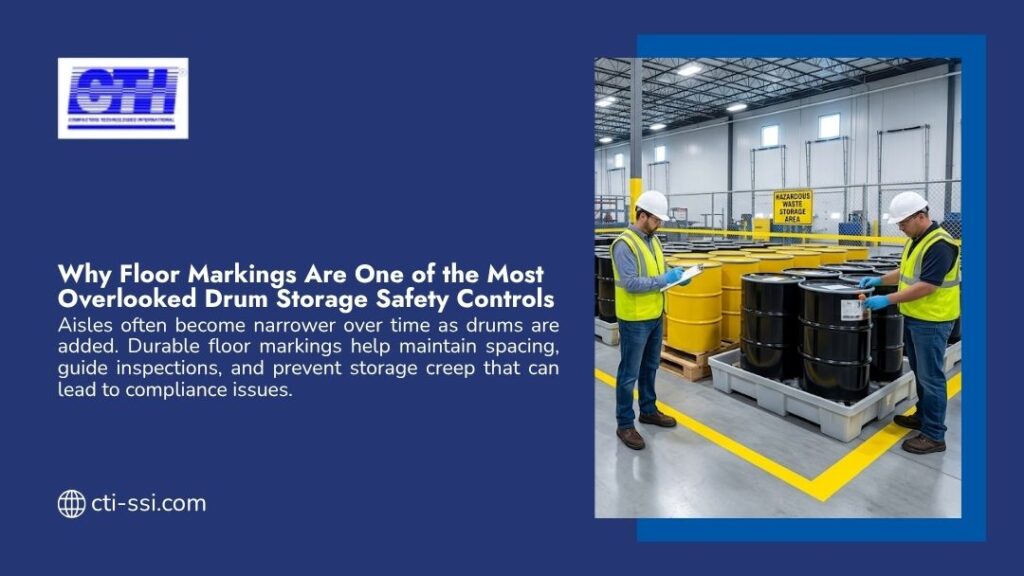
Facilities constantly balance storage capacity with access requirements. The goal is to place more drums without compromising the access quality that drum storage aisle spacing requirements demand. That balance is achievable with intentional layout logic from the start.
Practical optimization strategies:
- Zone-based layouts that assign specific areas to specific waste streams, with fixed aisles between each zone
- Dedicated inspection corridors that run the full length of the storage area without obstruction
- Controlled vertical stack within established limits (generally no more than two tiers for 55-gallon drums)
- Non-hazardous waste repositioned to lower-priority areas to free aisle width in the regulated zone
| Strategy | Primary Benefit | Compliance Outcome |
| Zone-based layout | Clearer hazard class separation | Fewer segregation violations |
| Dedicated inspection corridor | Consistent access for auditors | Lower citation risk at each review |
| Controlled vertical stack | More drum capacity per square foot | No reduction in aisle width |
| Non-hazardous drum repositioning | More space in regulated areas | Wider aisles in the high-risk zone |
How Much Aisle Space Is Actually “Enough”?
The answer depends on three factors: the access needs of emergency equipment on-site, the type of mechanical equipment used in the drum area, and the volume of pedestrian traffic during routine operations.
EPA enforcement documents reference approximately 2.5 feet as a practical working standard for adequate aisle space in hazardous waste storage areas. That figure is a minimum baseline, not a target.
Facilities with flammable liquid drums must also meet OSHA’s 1910.106 requirement of at least 3-foot aisles for access to doors, windows, and standpipe connections in flammable liquid storage rooms.
Key Takeaway: Why Drum Storage Aisle Spacing Is About Access, Not Distance
The principle that clarifies drum storage aisle spacing requirements at every facility level is this: inspectors evaluate accessibility, not exact measurements. The regulatory framework is performance-based.
A facility can have wide aisles and still fail if emergency equipment is unreachable. A facility can have modest aisles and pass every inspection if each pathway serves its intended function without obstruction.
| Common Myth | Regulatory Reality |
| A fixed aisle width exists in federal law | 40 CFR §265.35 gives no specific dimension |
| The 4-foot rule is enforceable OSHA law | That 1972 interpretation letter was withdrawn |
| Wide aisles alone guarantee compliance | Access quality, not width alone, determines outcome |
| Hazardous and non-hazardous drums share aisles without restriction | Hazard class separation requirements apply regardless of aisle width |
| Aisle floor markings are optional | OSHA 1910.176(a) requires permanent aisles to be appropriately marked |
For facilities that also need to review accumulation points at the source, satellite accumulation area requirements define how storage at the point of generation connects to the broader drum storage layout and overall RCRA compliance cycle.
Frequently Asked Questions
1. Is there a required minimum aisle width for drum storage?
No federal regulation specifies a fixed minimum aisle width for drum storage. Under 40 CFR §265.35, the requirement is that aisles allow unobstructed movement of personnel, fire protection equipment, spill control equipment, and decontamination equipment in an emergency.
The specific width is a facility-level determination based on equipment dimensions and access requirements.
2. Does OSHA specify drum storage aisle spacing?
OSHA does not set a universal fixed aisle width for drum storage. Under 29 CFR 1910.176(a), OSHA requires sufficient safe clearances for aisles where mechanical equipment is in use.
A 1972 Letter of Interpretation suggested at least 4 feet or 3 feet wider than the largest equipment, but that letter was subsequently withdrawn and carries no enforcement authority.
3. What determines aisle spacing in hazardous drum storage?
Drum storage aisle spacing requirements are shaped by the type of emergency equipment at the facility, the mechanical equipment used in the storage area, the hazard class of drum contents, and the access needs for routine inspection.
State-authorized programs may impose specific minimums. New Jersey requires 18 inches of aisle space for single-stacked 55-gallon drums.
4. Can forklift use affect drum storage aisle requirements?
Where forklifts or other mechanical equipment are used, OSHA 29 CFR 1910.176(a) requires aisles to provide sufficient safe clearances based on equipment dimensions and load sizes.
OSHA’s forklift eTool references approximately 12 feet as a general benchmark for counterbalanced lift trucks, though actual requirements vary by equipment type and layout.
5. What are the most common drum storage violations?
The most frequent violations in drum storage areas include blocked aisle access, poor waste type segregation, obstruction of emergency response equipment, missing aisle markings, and drums stacked above safe limits.
These categories appear most often in EPA and OSHA enforcement records for hazardous drum storage compliance reviews.
CTI Safety Storage: Compaction Equipment That Reduces Drum Count and Simplifies Compliance
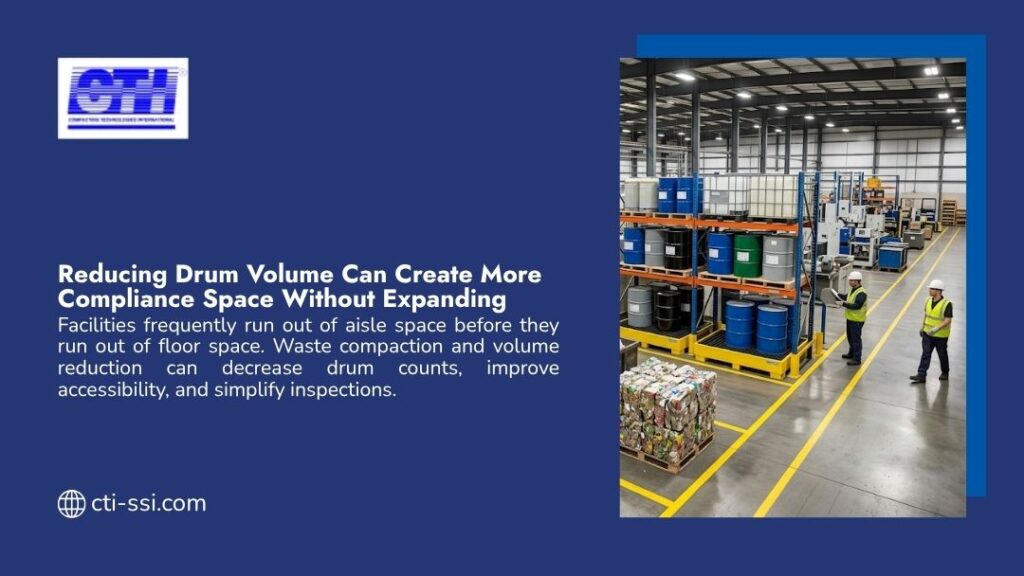
Drum storage aisle spacing requirements become harder to meet as drum count increases.
Every drum added to a central accumulation area reduces available aisle width, creates another inspection point, and adds a container that must be labeled, segregated, and audited on a weekly basis.
Reducing total drum volume is the most direct path to preserved aisle access and lower compliance exposure.
CTI Safety Storage designs and manufactures industrial waste compactors for hazardous, low-level radioactive, and specialized solid waste streams. Three core models support a range of hazard levels and output capacities:
| Model | Compaction Force | Key Safety Features |
| CTI 8040 | Standard range | Two-stage hydraulic system, PLC controls, safety interlocks |
| CTI 8550 | 60,000 lbs | NEMA 7 explosion-proof components, drum crush package, inert gas purge |
| CTI 8560 | 60,000 lbs | HEPA filtration at 99.97% to 0.3 microns, stainless steel platen, VOC/carbon filtration |
Optional configurations for compliance-sensitive environments include:
- NEMA 7 explosion-proof components for classified hazardous areas
- Liquid removal systems for solvent and chemical residue streams
- Fire suppression fittings for high-risk compaction scenarios
- Stainless steel platens and chambers for corrosive or radioactive decontamination
From an engineering perspective, the compliance benefit of compaction is concrete: fewer active drums means wider available aisles, fewer labels to audit, and fewer segregation points to track at each inspection cycle.
Contact CTI Safety Storage to request a quote or discuss a compaction solution matched to your waste stream, facility layout, and drum storage aisle spacing requirements.