Article Summary
- Satellite accumulation area requirements under 40 CFR §262.15 apply to all SQGs and LQGs under RCRA
- Each SAA can hold up to 55 gallons of non-acute hazardous waste without a RCRA permit
- California revised its SAA rules in 2024, consolidating all waste streams under one combined 55-gallon cap
- As of January 8, 2025, RCRA civil penalties reach up to $93,058 per day, per violation
- Waste compaction reduces active drum count and directly lowers the number of open SAA transfer deadlines
Satellite accumulation area requirements define how hazardous waste can sit at the point of generation before it reaches formal storage. For small and large quantity generators, these rules provide real operational flexibility.
This article covers what satellite accumulation area requirements demand, what changed in 2024 and 2025, and how compaction equipment reduces the number of active drums subject to these rules at any point in time.
For any generator that needs to establish which materials fall under this framework, the scope of RCRA hazardous waste sets the baseline for what belongs in an SAA.
What Are Satellite Accumulation Area Requirements?
A satellite accumulation area (SAA) is a storage location at or near the point of hazardous waste generation. It must be under the direct control of the operator who runs the process that produces the waste.
SAAs operate outside the RCRA permit scheme as long as quantity and procedural limits remain intact.
The federal baseline for satellite accumulation area requirements comes from 40 CFR §262.15. This regulation applies to both small quantity generators (SQGs) and large quantity generators (LQGs).
| Waste Category | SAA Quantity Limit | Action When Exceeded |
| Non-acute hazardous waste | 55 gallons per SAA | Transfer to CAA within 3 calendar days |
| Liquid acute hazardous waste | 1 quart per SAA | Transfer to CAA within 3 calendar days |
| Solid acute hazardous waste | 1 kilogram per SAA | Transfer to CAA within 3 calendar days |
Source: 40 CFR §262.15, eCFR updated April 2026
Federal rules set no ceiling on the number of SAAs a facility can operate. A plant with 15 separate waste-generating processes can set up a distinct SAA at each one, with each defined by its specific point of generation.
A cross-reference with hazardous waste examples by industry sector helps generators identify which waste streams require SAA-level controls for their specific facility type.
Where Satellite Accumulation Area Requirements Come From
The regulatory basis traces directly to RCRA and 40 CFR Part 262. EPA’s Hazardous Waste Generator Improvement Rule (HWGIR), finalized in 2016, introduced five key clarifications to SAA policy:
- Prohibition on incompatible wastes in the same SAA container
- Physical separation requirements between incompatible waste streams
- Clarification of operator control criteria for SAA designation
- Mandatory hazard identification label requirements for all SAA containers
- Application of emergency preparedness rules to all SAA locations
California adopted the RCRA Generator Improvements Rule under 22 CCR 66262.15, effective July 1, 2024. This eliminated per-stream counting for SAAs in the state.
All waste streams in a single SAA now count toward one combined 55-gallon cap, as confirmed by the Cal/EPA Unified Program Newsletter from March 2025.
Generators with multiple waste types in one SAA who relied on per-stream limits now face a tighter combined threshold.
Core Compliance Conditions for Every SAA
Beyond quantity limits, satellite accumulation area requirements set physical and procedural standards that apply at all times.
Container Standards
Every SAA container must:
- Be compatible with the specific waste type it holds
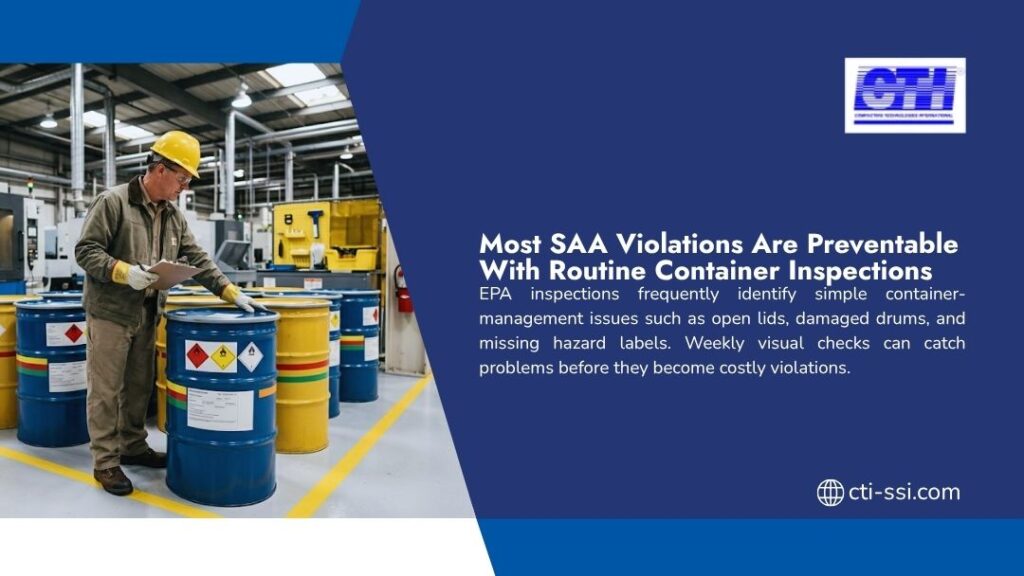
- Stay closed at all times except when waste is actively added or removed
- Remain in structurally sound condition with no leaks, corrosion, or deformation
- Not exceed the applicable quantity threshold at any point
Labels and Hazard Identification
Each container must carry a clear marking that identifies it as hazardous waste. The HWGIR further requires every container to state the specific hazard class of its contents.
A label that reads only “hazardous waste” without a hazard type does not meet the current federal standard.
| Label Element | Required at SAA Stage | Notes |
| “Hazardous Waste” marking | Yes | Must be visible and legible |
| Hazard class identification | Yes | Required under 2016 HWGIR |
| Accumulation start date | Only when limit is exceeded | Date the day the threshold is crossed |
| RCRA waste codes | No | Required before off-site shipment only |
For the full framework on label placement, content, and audit-ready format at every stage of accumulation, hazardous waste drum labeling requirements cover what EPA auditors check first during a site visit.
Operator Control and Emergency Preparedness
The operator of the generating process must maintain direct control of the SAA. A regular operational presence in the area is required. Locking a room that contains an SAA does not satisfy this standard on its own.
All SQG-operated SAAs must meet preparedness and prevention requirements under 40 CFR §262.16(b)(8). LQG-operated SAAs must comply with the full emergency preparedness, prevention, and response requirements under Subpart M of 40 CFR Part 262.
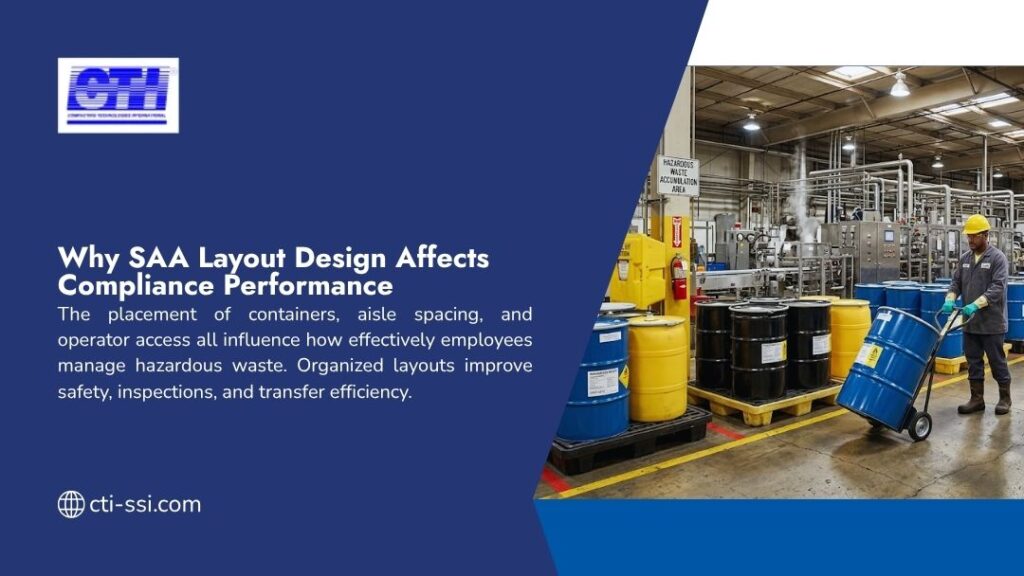
The 3-Day Transfer Rule
A critical component of satellite accumulation area requirements is the 3-day transfer rule.
When an SAA exceeds its quantity limit, the generator has three consecutive calendar days to move the waste to a Central Accumulation Area (CAA), an on-site permitted TSDF, or an off-site designated facility.
The clock does not pause for weekends or holidays.
| Step | Timing | Required Action |
| Threshold exceeded | Day 0 | Date the container; begin transfer |
| Transfer window | Days 1 to 3 | Move to CAA, on-site TSDF, or off-site facility |
| Transfer missed | Day 4 onward | RCRA violation accumulates daily |
| Penalty exposure | Per day, per violation | Up to $93,058 as of January 8, 2025 |
Source: 40 CFR §262.15(a)(6); EPA RCRA penalty update, January 8, 2025
Most facilities move the full container to the CAA rather than just the excess. This approach avoids label confusion at the point of transfer and resets the SAA with a clean container.
Enforcement Data and SAA Compliance Risk
Satellite accumulation area requirements violations carry substantial financial exposure. As of January 8, 2025, RCRA civil penalties under Section 3008(g) reach $93,058 per day, per violation.
Fines accrue daily. A 10-day transfer delay is not one violation. It is 10 violations, each at full penalty exposure.
EPA’s FY2025 enforcement data puts the compliance environment in direct terms:
- 2,127 civil enforcement cases concluded, the highest count in nine fiscal years
- 156 defendants charged, the most since 2016
- Over $600 million in total fines, restitution, and court-ordered relief
As of November 2025, the EPA e-Manifest system tracked over 6 million tons of hazardous waste shipped from 592,068 generating facilities across the U.S.
| Common SAA Violation | Regulatory Reference |
| Label missing or illegible | 40 CFR §262.15(a)(4) |
| Container left open | 40 CFR §262.15(a)(2) |
| Volume exceeded with no date or transfer | 40 CFR §262.15(a)(6) |
| Incompatible wastes in the same container | 40 CFR §262.15(a)(3) |
| No emergency preparedness at SQG SAA | 40 CFR §262.16(b)(8) |
Source: RCRAReady; EPA RCRA civil penalty data, January 2025
Auditors also evaluate whether waste was properly identified before it entered the SAA.
Knowledge of the characteristics of hazardous waste, specifically ignitability, corrosivity, reactivity, and toxicity, determines whether a substance requires SAA controls from the start.
A misidentified waste stream can expand a label violation into a full hazardous waste determination failure.
How Compaction Equipment Reduces SAA Compliance Exposure
Each drum in active accumulation is an active compliance point. It needs a current label, a condition check, and a volume count toward the SAA limit. When the total drum count drops, the number of open compliance obligations drops with it.
CTI Safety Storage designs and manufactures industrial waste compactors for hazardous, low-level radioactive, and specialized solid waste streams. Their product line covers three core models with distinct force output levels and safety specifications.
| Model | Compaction Force | Core Features | Primary Application |
| CTI 8040 | Standard range | Two-stage hydraulic, PLC controls, safety interlocks | Light hazardous waste streams |
| CTI 8550 | 60,000 lbs | NEMA 7-rated components, drum crush package, inert gas purge | Solvent and chemical-heavy facilities |
| CTI 8560 | 60,000 lbs | HEPA filtration at 99.97% to 0.3 microns, stainless steel platen, VOC/carbon filtration | Radioactive and corrosive waste streams |
Optional system configurations extend material compatibility for classified environments:
- NEMA 7 explosion-proof components for hazardous classified areas
- Liquid removal systems rated for solvent and chemical residues
- Fire suppression fittings for high-risk compaction scenarios
- Stainless steel platens and chambers for decontamination-grade applications
In my experience with hazardous waste management equipment, the compliance value of compaction comes down to one thing: load reduction.
Fewer active drums means fewer quantity thresholds to monitor, fewer transfer clocks in motion, and fewer containers subject to audit review at each compliance cycle.
For facilities that route compacted waste into drum-based storage before off-site shipment, a review of secondary containment requirements for drums confirms what containment standards apply at the CAA stage once volume is reduced.
Frequently Asked Questions
What is the 55-gallon rule for satellite accumulation areas?
Under 40 CFR §262.15, a generator can hold up to 55 gallons of non-acute hazardous waste per SAA without a RCRA permit. For acute hazardous waste, the limit is 1 quart of liquid or 1 kilogram of solid.
When either threshold is crossed, the generator has three consecutive calendar days to transfer the waste to a CAA or approved facility.
How many SAAs can one facility operate?
Federal RCRA regulations set no ceiling on the number of SAAs at a single facility. Each must be at or near its specific point of waste generation and under the direct control of the operator responsible for that process.
What happens when an SAA exceeds its volume limit?
The three-day transfer rule under satellite accumulation area requirements requires the generator to date the container on the day of the overage and move the waste to a CAA, an on-site TSDF, or an off-site designated facility within three consecutive calendar days.
What are the label requirements for SAA containers?
Each container must be marked as “hazardous waste” and must identify the specific hazard class of its contents.
Accumulation start dates are required only on containers that hold waste beyond the quantity limit. RCRA waste codes must appear on the container before off-site shipment.
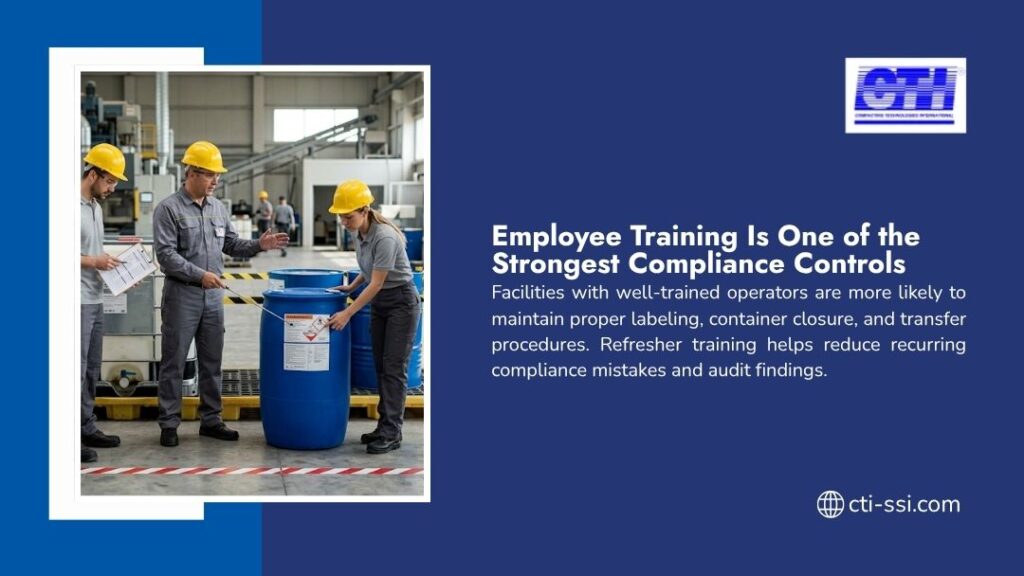
Reduce SAA Volume. Reduce Transfer Exposure.
Correct application of satellite accumulation area requirements is a baseline obligation for every SQG and LQG.
For facilities with high waste output, every active drum near the SAA limit is an active transfer deadline, an active inspection point, and an active source of compliance exposure.
CTI Safety Storage designs and manufactures industrial waste compactors built for hazardous, low-level radioactive, and specialized solid waste streams.
Each system reduces the total number of active drums across your SAA and CAA cycle, which directly lowers the number of open transfer deadlines and the compliance risk tied to drum volume.
CTI compactor features for compliance-sensitive applications:
- HEPA filtration at 99.97% efficiency, rated to 0.3 microns, for particulate-laden waste streams
- NEMA 7 explosion-proof components for classified hazardous environments
- Stainless steel platens and chambers for corrosive or radioactive decontamination applications
- Liquid removal systems rated for solvent and chemical residues
- 60,000 lbs. of compaction force on the CTI 8550 and CTI 8560 models
Fewer drums mean fewer SAA thresholds in motion, fewer transfer clocks to track, and less compliance exposure at every stage of the waste cycle.
Get in touch with CTI Safety Storage to request a quote and discuss a compaction solution matched to your waste stream, facility layout, and satellite accumulation area requirements.