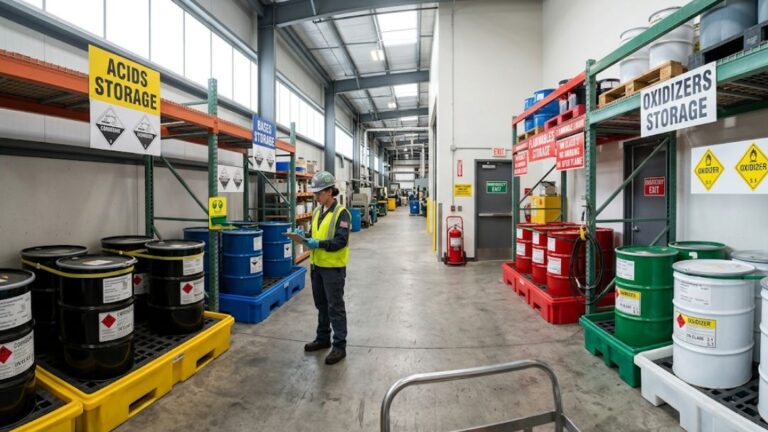
Article Summary
- Weekly drum inspection requirements under RCRA apply to all LQGs and SQGs that store hazardous waste on-site
- As of January 8, 2025, RCRA civil penalties reach $93,058 per day, per violation
- The 7-calendar-day interval is strict — a walk-through without a written log holds no compliance value
- This guide covers the regulatory basis, what to check, how to document, and what auditors prioritize
Weekly drum inspection requirements are a federal obligation under the Resource Conservation and Recovery Act.
The standard is clear: inspect every 7 calendar days, document every result, and maintain records that can hold up during a surprise audit.
As of January 8, 2025, RCRA civil penalties reach $93,058 per day, per violation — and fines accrue on a daily basis.
This guide covers exactly what weekly drum inspection requirements demand: what to check, how to record it, and how to avoid the documentation gaps that drive most RCRA enforcement actions.
What Are Weekly Drum Inspection Requirements?
Weekly drum inspection requirements are a federal obligation under RCRA for any facility that accumulates hazardous waste on-site.
The mandate applies to Large Quantity Generators (LQGs) under 40 CFR § 262.17(a)(1)(v) and Small Quantity Generators (SQGs) under 40 CFR § 262.16(b)(2)(iv).
Very Small Quantity Generators (VSQGs) are exempt.
According to “New Pig” research, any Central Accumulation Area (CAA) where hazardous waste is held during the 90, 180, or 270-day accumulation period must receive at least one inspection every 7 calendar days.
Before any inspection begins, a solid grasp of OSHA drum storage requirements establishes the physical standards each container and storage area must already meet.
| Inspection Element | Included? | Notes |
| Container condition (rust, dents, bulges) | Yes | Every drum in the CAA |
| Leaks and surface residue | Yes | Visual check at seams and bungs |
| Labels and accumulation dates | Yes | Must be legible and accurate |
| Lid and closure status | Yes | Closed at all times except during waste transfer |
| Aisle access and secondary containment | Yes | Must be clear and functional |
| Accumulation deadline status | Yes | Flag drums near the 90/180/270-day limit |
Why Weekly Drum Inspections Matter for Compliance and Safety
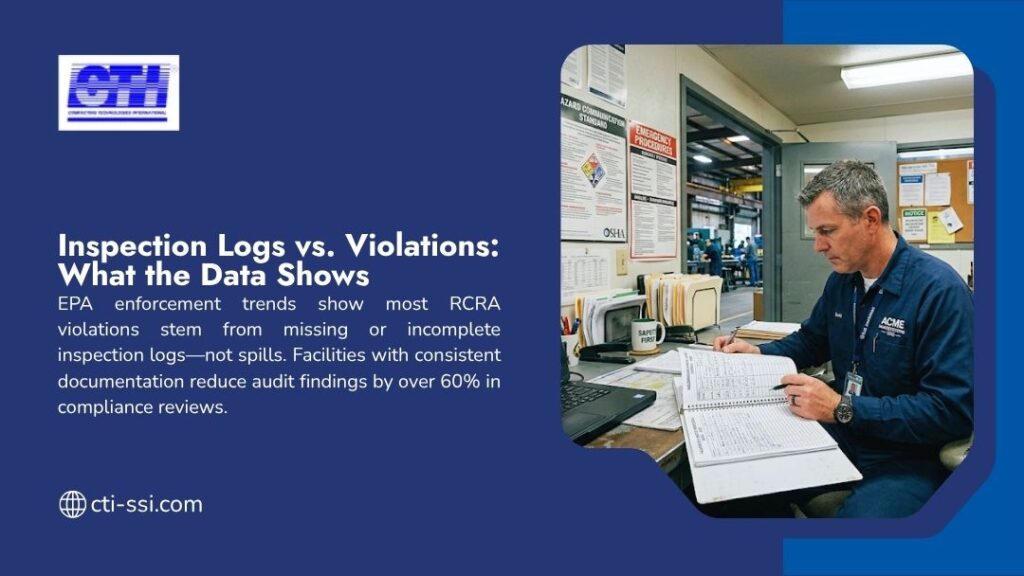
Most violations happen not because inspections are skipped, but because they are executed without adequate records.
The majority of RCRA civil penalties come from administrative failures: a drum without an accumulation date, a missed log entry, an open container found during a walk-through.
These are not accidental spills. They are documentation gaps that EPA inspectors find in the first 30 minutes on-site.
A solid foundation in RCRA hazardous waste rules makes clear why the weekly cadence is non-negotiable.
For example, a South Carolina specialty chemical producer received 10 RCRA citations and a $121,600 fine in Q4 2025 for open containers and label errors found during a single compliance visit.
| Consequence | Trigger | Exposure |
| Civil penalty | Missed or incomplete inspection | Up to $93,058/day/violation |
| Multi-program audit | Single label error | Air, Water, EPCRA records also reviewed |
| Personal liability | Willful violations | Individual EHS managers can be held liable |
| Six-figure settlement | Documentation failures only | Stericycle paid $9.5M in 2025 for recordkeeping failures |
What Must Be Checked During Weekly Drum Inspections
Container Condition
Every drum requires a close-range structural check. Surface rust is a cosmetic issue. Rust that has penetrated the drum wall is a structural failure and must be addressed before the next shift.
Look for:
- Dents or deformation along the drum body or seams
- Bulging at the drum top or base
- Corrosion that has broken through the outer wall
- Cracks or residue buildup at the bung or closure points
Even minor corrosion can lead to major issues. A drum in deterioration that is not yet leaking still represents a container management violation if left in place without action.
Leaks and Spills
Wet spots on exterior surfaces, discoloration at seams, and crystallized residue around bungs are the first items EPA auditors examine. A drum with liquid visible on its exterior surface is a drum with migrating contents.
| Inspection Area | What to Check | Non-Compliance Signs |
| Drum body | Dents, deformation, rust penetration | Visible metal breakdown |
| Seams | Weld integrity | Residue or separation at weld line |
| Bungs and closures | Tight seal, no residue | Crystallized material, staining |
| Underside and containment tray | No wet spots or staining | Pooled liquid in the secondary containment area |
Labels and Identification
Missing labels are among the fastest routes to a citation. Every drum must carry a legible hazardous waste label with waste identification, accumulation start date, and generator contact details.
A faded or obscured label carries the same penalty weight as no label at all. Labels must be readable from a standard upright position without physical drum movement.
Closure and Sealing
Every container must remain closed at all times, except when waste is actively added or removed. An open container found during an EPA visit is a citable violation without exception.
Check that lids are fully seated, bungs are hand-tight, and no caps rest loosely on top of any drum.
Storage Area Condition
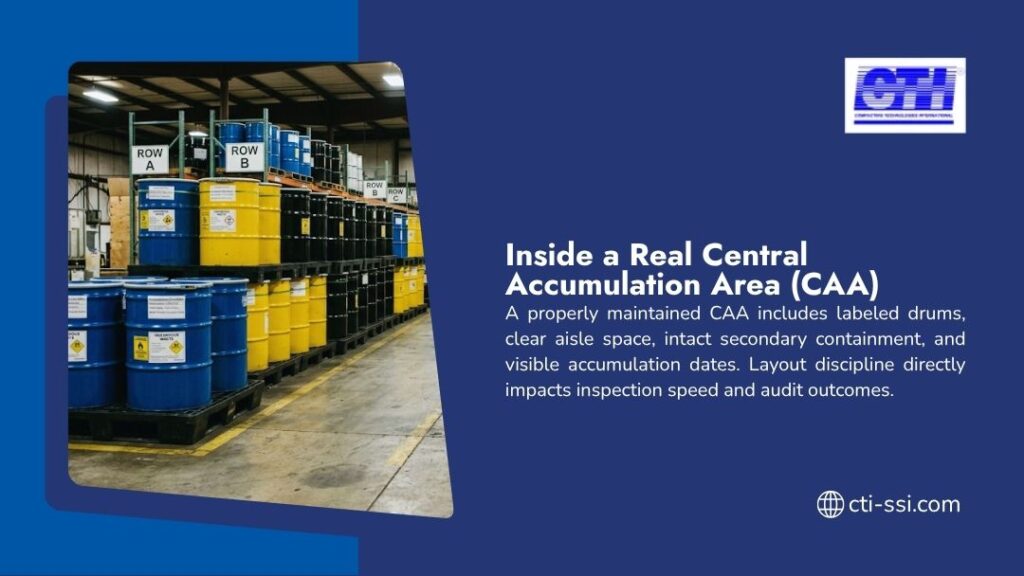
The condition of the area around drums is part of the inspection. Aisle access must remain unobstructed at all times.
A review of secondary containment requirements for drums confirms what structural standards the containment tray and drum spacing must meet throughout the accumulation period.
| Storage Area Element | Compliance Standard | Common Issue |
| Aisle clearance | Emergency access must be maintained | Pallets or equipment in walkway |
| Secondary containment | Intact, no accumulated liquid | Cracked trays, unresolved spills |
| Drum spacing | Incompatible waste types separated | Mixed streams without proper segregation |
Step-by-Step Weekly Drum Inspection Process
Pre-Inspection Preparation
Collect the inspection log, a written checklist, and full PPE before the walk-through begins. A verbal-only review holds no compliance value.
Minimum PPE for CAA entry:
- Chemical-resistant gloves rated for the specific waste streams present
- Safety glasses or a face shield
- Chemically resistant footwear
- Respiratory protection where volatile waste is stored
Physical Inspection of Drums
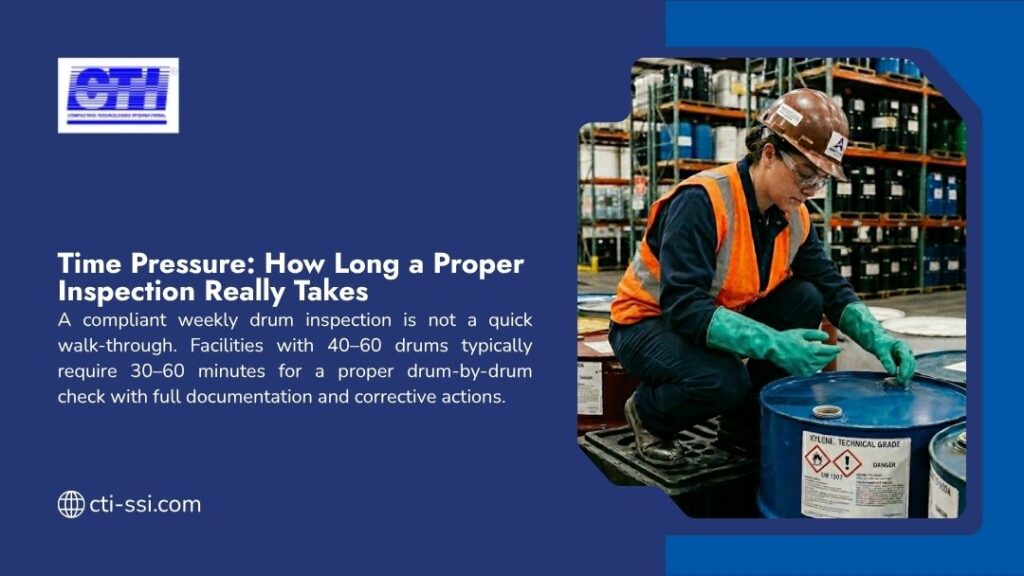
Move through the storage area drum by drum. Do not assess rows from a distance. EPA auditors perform close-range drum-level checks, and your weekly log must reflect the same standard.
For drum movement during the inspection process, a drum handling safety protocol must be established before any container is repositioned for closer assessment.
| Step | Action | Key Note |
| 1 | Collect checklist, log, and PPE | No inspection starts without documentation in hand |
| 2 | Enter CAA and start at the first drum | Work drum by drum in a consistent sequence |
| 3 | Check condition, label, and closure on each drum | Flag any deficiency before moving to the next container |
| 4 | Inspect containment area and aisle access | Note any liquid accumulation or obstruction |
| 5 | Record all results before exit | Date, time, inspector name, and drum-level observations |
| 6 | Initiate corrective action for flagged drums | Document the action taken and time of resolution |
Recording Findings
Document every inspection on the same day it takes place. Back-dated or reconstructed records are a data integrity violation under RCRA. The log must include date, time, inspector name, drum identifiers, condition notes, and any corrective steps taken.
Corrective Actions
Any confirmed deficiency requires immediate, documented action. Standard options include:
- Overpack the drum in a larger compliant container
- Transfer contents to a new drum with a fresh label and updated accumulation date
- Contact the waste coordinator and schedule emergency off-site shipment if contents cannot be safely held on-site
Documentation and Recordkeeping Requirements
What Must Be Documented
Every weekly drum inspection must produce a written record. Required elements:
- Inspection date and time
- Inspector full name and role
- Drum-level condition findings for each container
- Any corrective actions with timestamps and responsible party noted
How Long Records Should Be Kept
RCRA requires inspection logs to be retained for at least three years from the date of each inspection. State programs may set longer retention periods. Records must be accessible on-site during any compliance evaluation.
| Documentation Element | Minimum Requirement | Best Practice |
| Date and time | Required for every entry | Digital timestamp at point of inspection |
| Inspector name | Full name required | Include role designation |
| Container condition | Drum-level notation | Specific observations, not blanket “all OK” entries |
| Corrective action | Required if deficiency found | Timestamp with responsible party identified |
| Retention period | 3 years minimum | Digital backup with multi-location access |
Digital vs Paper Logs
Paper logs are compliant. However, a binder stored in one office is inaccessible when a surprise inspection begins in the storage area.
As of September 19, 2025, EPA launched the Hazardous Waste Information Platform to replace the older RCRAInfo system, a direct reflection of the broader shift toward digital compliance tools.
Digital logs accessible from multiple devices allow an EHS manager to retrieve last week’s record while present in the CAA with an auditor.
3 Common Mistakes That Lead to Violations
- Inconsistent Inspection Cadence
The 7-calendar-day interval is strict. A facility that inspects on a Monday one week and the following Thursday the next has created a gap of more than 7 days. That gap is a violation regardless of how thorough each individual inspection was.
- Superficial Visual Checks
A walk-through that covers an entire storage area in under five minutes will not survive scrutiny. EPA auditors perform close-range, drum-level checks. Weekly drum inspection requirements demand the same standard from every designated inspector.
- Poor Recordkeeping
A Nebraska rubber manufacturer received a $153,174 RCRA fine in Q4 2025 for absent records and failure to make accurate hazardous waste determinations. The violation was administrative, not a release event.
| Mistake | Regulatory Impact | Correction |
| Gap over 7 days between inspections | Direct RCRA violation | Fix the inspection to the same calendar day each week |
| Distance-only visual review | Fails audit standard | Inspect each drum at close range, drum by drum |
| Back-dated or reconstructed logs | Data integrity violation | Document same-day, every time |
| Minor corrosion left unaddressed | Non-compliant container in storage | Overpack or transfer contents before the next shift |
What Inspectors Look for During Audits
EPA Compliance Evaluation Inspections (CEIs) assess the same items that weekly drum inspection requirements are built to catch.
Inspectors arrive unannounced and begin with the log.
A missing entry from the previous week escalates the audit scope immediately. A single label error often triggers a full review of Air, Water, and EPCRA records at the same facility visit.
Inspectors also cross-reference accumulation start dates against the inspection log. A drum at day 62 with a 10-day gap in the record creates two violation categories at once: deadline proximity and inspection frequency failure.
| Audit Focus Area | What Inspectors Look For | Common Issue |
| Inspection log | Entry for every 7-day interval | Absent dates or date gaps |
| Container labels | Legible waste ID and accumulation date | Faded, obscured, or absent labels |
| Container condition | No leaks, structural damage, or corrosion | Deteriorated drums left in place |
| Closure status | All containers closed | Open lids or loose bungs |
| Secondary containment | Intact, no accumulated liquid | Cracked trays, unresolved spills |
How to Build a Consistent Weekly Inspection System
Consistency is a system output, not an individual one. A compliance program that depends on one person’s memory will eventually produce a missed week and a violation.
Fix the inspection to the same calendar day each week. Assign a primary inspector and a named backup. Attach the inspection task to shift handover so it becomes part of a routine rather than a separate obligation.
Steps to build a reliable inspection program:
- Assign a fixed inspection day with a primary and backup inspector named in the SOP
- Create a standard checklist tied to your specific drum types and waste streams
- Store logs in a location accessible from both the storage area and the main office
- Conduct quarterly internal audits of your inspection records to catch scheduling gaps before an external auditor does
- Train all designees on RCRA documentation standards alongside the physical inspection technique
For facilities that handle varied container formats, clarifying what qualifies as a hazardous waste barrel under federal definitions confirms which containers fall under weekly drum inspection requirements and which do not.
Frequently Asked Question
What are the exact requirements for weekly drum inspections?
LQGs and SQGs must inspect hazardous waste Central Accumulation Areas every 7 calendar days under 40 CFR § 262.17(a)(1)(v) and 40 CFR § 262.16(b)(2)(iv), with a written record maintained for every inspection.
What should be included in a drum inspection checklist?
A compliant checklist must cover container condition, leak and residue status, label accuracy and legibility, closure status, secondary containment integrity, and accumulation date against the applicable storage deadline.
How often do hazardous waste drums need to be inspected?
LQGs and SQGs must inspect storage areas at least once every 7 calendar days. VSQGs are not subject to this requirement under federal RCRA rules.
Who is responsible for drum inspections?
The generator is responsible. In practice, the EHS manager or a trained and designated team member conducts each inspection and signs the log.
What are inspectors looking for during an audit?
Auditors start with the inspection log, then check container labels, closure status, structural condition, and secondary containment. A single absent log entry can expand the audit into multiple EPA program areas.
Reduce Drum Volume. Reduce Inspection Exposure.
Correct execution of weekly drum inspection requirements is a baseline obligation for every LQG and SQG.
For facilities with high drum volumes, every additional container in storage is an additional inspection point, an additional accumulation deadline, and an additional source of compliance exposure.
CTI Safety Storage designs and manufactures industrial waste compactors built for hazardous, low-level radioactive, and specialized solid waste streams.
Each system reduces the total number of active drums in your CAA, which directly lowers weekly inspection workload and the compliance risk tied to drum volume.
CTI compactor features for compliance-sensitive applications:
- HEPA filtration at 99.97% efficiency, rated to 0.3 microns, for particulate-laden waste streams
- NEMA 7 explosion-proof components for classified hazardous environments
- Stainless steel platens and chambers for corrosive or radioactive decontamination applications
- Liquid removal systems rated for solvent and chemical residues
- 60,000 lbs. of compaction force on the CTI 8550 and CTI 8560 models
CTI clients have documented up to $170,000 in annual disposal cost reductions through drum volume compaction. Fewer drums mean fewer inspections, fewer active compliance deadlines, and less exposure at every stage of the waste cycle.
Get in touch with CTI Safety Storage to request a quote and discuss a compaction solution matched to your waste stream, facility layout, and compliance requirements.