Article Summary:
- Drum handling safety requires hazard identification, proper PPE, and compliant movement procedures
- OSHA and EPA set binding standards for drums that contain hazardous, flammable, or radioactive materials
- Mechanical aids are the correct tool for drums above safe manual lift thresholds
- Correct storage, labeling, and segregation protect workers and support regulatory compliance
- Consistent workforce preparation is the foundation of long-term incident prevention
A full 55-gallon steel drum can weigh over 400 pounds. When that drum holds a solvent, chemical reagent, or low-level radioactive material, poor drum handling safety procedures carry consequences that extend far beyond physical strain.
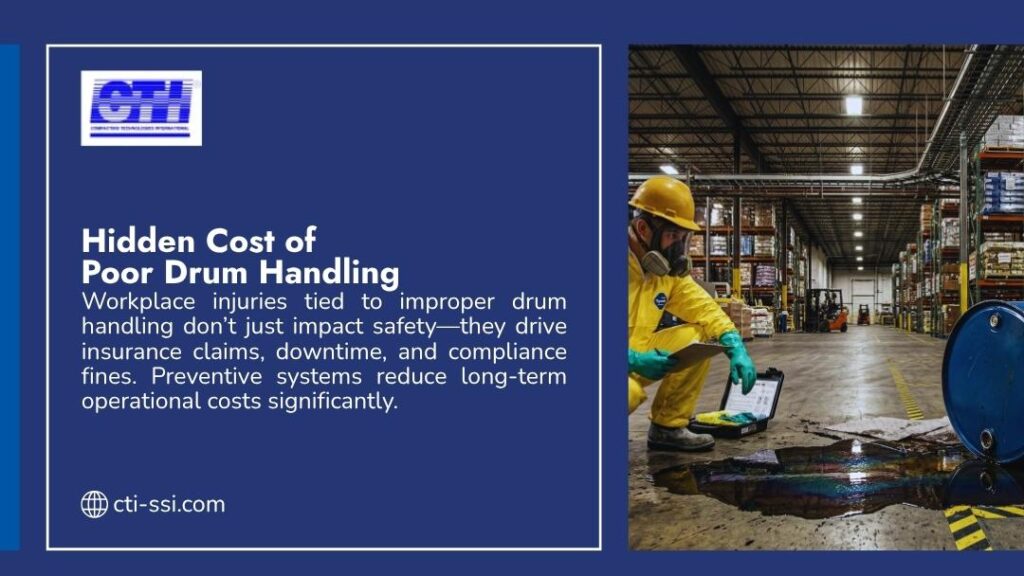
Spills, flash fires, toxic exposure, and crush injuries are all documented outcomes of improper industrial drum operations.
For EHS managers, facility supervisors, and plant operators, drum handling safety is an active operational obligation that touches worker protection, environmental compliance, and organizational liability at once.
This guide covers hazard identification, regulatory requirements, movement techniques, equipment selection, and workforce preparation for drum operations across industrial and waste management contexts.
For facilities evaluating what happens at a drum’s operational end, how to dispose of 55 gallon drums outlines the compliant pathway for final disposition.
Drum Handling Safety Risks Every Facility Must Address
The foundation of any drum handling safety program is a thorough assessment of what makes these containers dangerous before work begins.
A standard 55-gallon drum filled with liquid weighs between 400 and 500 pounds depending on content density. That weight alone creates immediate risk of musculoskeletal injury.
Add a hazardous chemical, flammable solvent, or radioactive material to that weight, and the hazard profile expands substantially.
Facilities that store flammable drums indoors should confirm their storage areas meet current flammable cabinet requirements before drums are staged or left in position for accumulation.
| Drum Content Type | Primary Hazard | Potential Consequence |
| Flammable solvents | Fire and explosion | Facility damage, fatality |
| Corrosive chemicals | Skin and eye contact | Chemical burns, blindness |
| Toxic compounds | Inhalation or absorption | Organ damage, chronic illness |
| Radioactive waste | Radiation exposure | Contamination, long-term health effects |
| Pressurized contents | Sudden release | Explosion, projectile risk |
| “Empty” residual drums | Vapor accumulation | Ignition risk, toxic exposure |
Common Types of Drum Hazards
Industrial drum handling exposes workers to six recognized hazard categories. Each one requires a different protective response at the movement, storage, and disposal stage.
- Flammable and combustible drums hold organic solvents, fuels, or paint-related waste. Spark-free tools and explosion-proof equipment are required in their immediate work area.
- Corrosive drums contain acids, alkalis, or reactive cleaners. These can degrade container material over time, which makes pre-movement inspection critical before any contact.
- Toxic compound drums may carry no visible warning. Accurate labels, current SDS documentation, and appropriate respiratory protection are the primary lines of defense.
- Radioactive waste drums fall under NRC and DOE oversight. Contamination controls must remain active throughout every stage of movement and storage.
- Pressurized drums require verified pressure checks before any tilt or stack. High ambient temperatures accelerate internal buildup and raise ejection risk.
- “Empty” drums with residual content remain among the most underestimated hazards in drum operations. Vapor concentration inside a drum previously used for flammable solvents has caused ignition in documented industrial incidents.
| Hazard Type | Minimum PPE | Primary Risk Factor |
| Flammable | Chemical gloves, FR clothing, face shield | Ignition from spark or static discharge |
| Corrosive | Acid-resistant gloves, goggles, apron | Container failure and direct skin contact |
| Toxic | NIOSH-approved respirator, chemical gloves | Inhalation and dermal absorption |
| Radioactive | Full-body suit, dosimeter, respirator | Contamination and cumulative radiation dose |
| Pressurized | Face shield, safety gloves | Uncontrolled pressure release |
| Residual (“empty”) | Respirator, gloves | Vapor buildup and ignition risk |
OSHA Drum Handling Guidelines and Regulatory Compliance
Drum handling safety falls under a framework of federal standards enforced by OSHA, EPA, and DOT. Facilities that handle drums with hazardous content must comply with all three agencies, as each governs a distinct part of the operation.
Key OSHA standards applicable to drum operations:
- 29 CFR 1910.176 — Materials Handling and Storage: specifies load stability, aisle clearance, and mechanical aid requirements for all heavy material movement
- 29 CFR 1910.120 (HAZWOPER) — requires formal hazardous waste operations training for workers who handle regulated waste drums
- 29 CFR 1910.1200 (Hazard Communication) — mandates proper labeling and SDS access for all hazardous chemical drums on-site
Under EPA’s Resource Conservation and Recovery Act (RCRA), facilities that generate, accumulate, or transfer hazardous waste drums must obtain an EPA identification number before any off-site transfer.
Facilities should review osha drum storage requirements to confirm that their accumulation areas meet current regulatory criteria. DOT regulations under 49 CFR Part 173 govern packaging, labeling, and transport of hazardous drums.
Civil penalties for DOT violations can exceed $75,000 per incident under current enforcement schedules.
Best Practices for Drum Handling Safety
Effective chemical drum safety in operations follows a structured workflow from initial inspection through final disposal. Each stage has specific requirements that reduce incident risk and maintain compliance with applicable standards.
| Workflow Stage | Required Action | Purpose |
| Pre-check | Label verification, container inspection, environment review | Confirm identity, detect damage |
| PPE selection | Match protection level to drum content type | Prevent exposure before contact |
| Movement | Use mechanical aids for all drums above 50 lbs | Reduce musculoskeletal injury risk |
| Staging | Confirm surface stability, ventilation, segregation | Prevent tipping and vapor accumulation |
| Storage | Follow stacking limits and compatibility rules | Maintain structural integrity and compliance |
| Disposal | Follow regulatory pathway for content type | Maintain RCRA and DOT compliance |
Reviewing hazardous waste examples relevant to your facility helps identify which drums in your waste stream require elevated protocols at each stage of this workflow.
Drum Handling Safety Checks Before Any Movement
Every drum movement should begin with a structured inspection. This step is fundamental to drum handling safety in any facility where mixed waste streams are present, and it cannot be skipped under operational time pressure.
Pre-check procedure:
- Confirm the drum label matches the SDS on file for that material
- Inspect the exterior for dents, corrosion, seam damage, or bulging
- Verify bung caps and seals are secure with no visible leakage
- Check for residue, discoloration, or staining around the drum base
- Assess the floor for spills, obstructions, or uneven terrain in the movement path
- Confirm ventilation is adequate before work begins in any enclosed space
A bulging drum may indicate internal pressure buildup and must not be moved without supervisor review and SDS consultation. An unlabeled drum should be treated as hazardous until its content is verified through documentation or lab analysis.
Proper Lifting and Drum Movement Safety Techniques
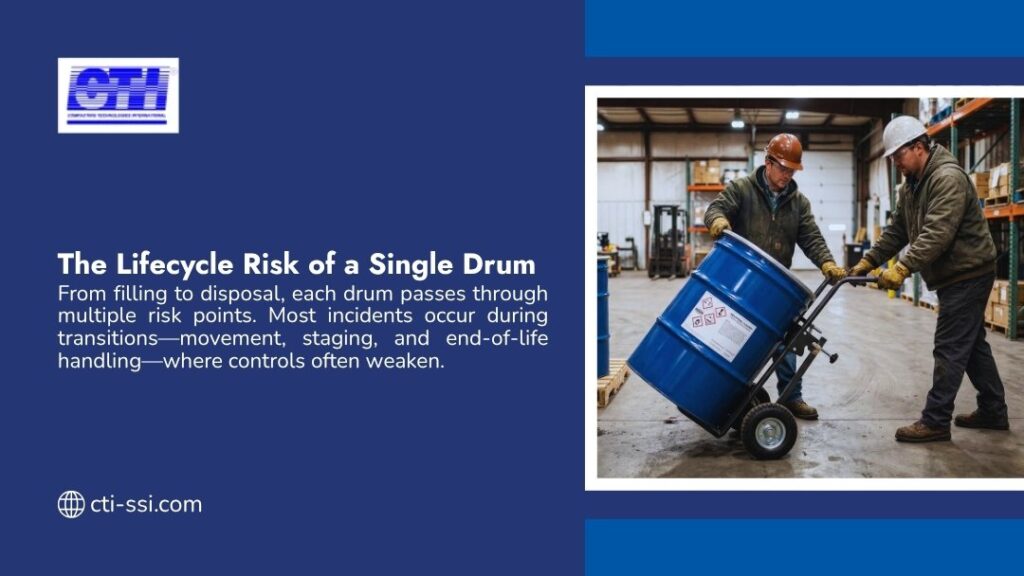
Manual drum movement is a primary source of soft tissue and musculoskeletal injury in industrial settings. OSHA ergonomics guidance identifies heavy material movement as a high-risk activity, particularly without mechanical support.
The general industry threshold for solo manual lift is 50 pounds or less. A full 55-gallon liquid drum exceeds this limit by a factor of eight or more. Mechanical aids are not supplemental for drum movement safety at this weight range — they are the correct tool for the job.
| Movement Method | Max Safe Capacity | Advantages | Limitations |
| Manual (two-person) | Up to 100 lbs | No equipment required | High injury risk, slow |
| Drum dolly / hand truck | 400–800 lbs | Low cost, portable | Requires flat stable surface |
| Drum lifter (forklift attachment) | 1,000+ lbs | High capacity, precise | Requires certified forklift operator |
| Drum carousel / pallet jack | 400–1,200 lbs | Stable for multiple drums | Limited to flat floor conditions |
| Overhead hoist with drum grab | 1,000+ lbs | Optimal for elevated placement | Requires overhead structural capacity |
RCRA hazardous waste classification also affects drum movement protocols. Hazardous waste drums carry accumulation time limits that vary by generator status.
Drums approaching those limits require movement to an approved transfer or disposal facility within the allotted time window or the facility faces regulatory violation.
Drum Storage Safety and Stacking Guidelines
Drum storage safety requires more than available floor space. OSHA 29 CFR 1910.176 specifies that stored materials must be stacked to provide stability and prevent sliding, tipping, or collapse.
This requirement applies directly to drum storage areas in industrial and waste management facilities.
Core drum storage safety requirements:
- Steel drums should not be stacked above two high without appropriate rack support
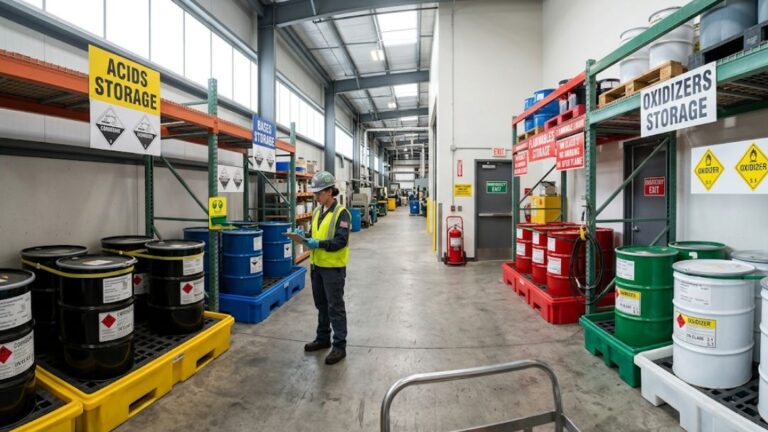
- Incompatible chemical drums must be separated by hazard class to prevent accidental mixing
- Flammable drum storage areas require ventilation, bonding, and grounding of all containers
- Outdoor storage areas require secondary containment to prevent stormwater runoff contamination
- All stored drums must remain fully labeled and legible at all times
Reviewing the full spectrum of types of hazardous waste at your facility supports proper segregation decisions and prevents incompatible materials from occupying adjacent storage positions.

Equipment Selection and Maintenance for Drum Operations
The right equipment eliminates unnecessary manual contact with heavy or hazardous drums and reduces exposure during transfer, staging, and compaction. Selection should be based on drum weight, content type, floor conditions, and the frequency of movement at your facility.
| Equipment | Capacity | Best Application | Key Safety Feature |
| Drum dolly | 400–800 lbs | Floor-level movement | Low center of gravity |
| Forklift drum attachment | 1,000+ lbs | Loading, staging, transport | Cage and retention system |
| Industrial drum compactor | Varies by model | Volume reduction before disposal | NEMA 7 explosion-proof options |
| Drum vacuum system | N/A | Residual content removal | Sealed, closed-loop transfer |
| Secondary containment pallet | N/A | Storage area staging | Integrated spill containment |
A drum crusher or industrial waste compactor is a high-value asset for facilities that process large volumes of steel or fiber drums.
Compaction systems built for hazardous material applications include NEMA 7 explosion-proof electrical components, liquid removal systems for saturated waste streams, and HEPA filtration to capture particulates and VOCs during the compaction cycle.
These capabilities are not present in standard-grade compactors.
Equipment maintenance checklist:
- Inspect hydraulic lines and fittings for leaks before each operational shift
- Verify load ratings and confirm no unauthorized modifications to any rated equipment
- Test safety interlocks and emergency stop functions on a weekly schedule
- Log all inspections with date, operator name, and findings on record
- Replace worn components on a scheduled basis — not after a failure event
CTI Safety Storage manufactures industrial waste compactors engineered specifically for hazardous and radioactive waste applications.
The CTI 8040, CTI 8550, and CTI 8560 include two-stage hydraulic systems, NEMA 7 explosion-proof components, stainless steel platen and chambers for decontamination, and optional HEPA/VOC filtration.
From an engineering standpoint, these features address the specific safety gaps that general-purpose compactors leave unresolved when applied to chemical or radioactive waste streams.
Training and Workplace Safety Culture
Technical knowledge of drum handling safety procedures has limited value without consistent application across the workforce. Formal training programs, enforced SOPs, and visible safety culture are what convert written procedures into daily operational practice.
OSHA 29 CFR 1910.120 (HAZWOPER) requires 40-hour initial training for workers with routine hazardous waste drum exposure, plus annual 8-hour refresher courses.
Supervisors in hazardous waste environments require an additional 8 hours of specialized instruction beyond the standard worker curriculum.
| Training Component | Required Frequency | Regulatory Basis |
| Initial HAZWOPER | Before first hazardous waste assignment | OSHA 29 CFR 1910.120 |
| Annual HAZWOPER refresher | Yearly | OSHA 29 CFR 1910.120 |
| Hazard Communication / GHS / SDS | At hire; updated with new hazards | OSHA 29 CFR 1910.1200 |
| Equipment operation and inspection | Before first use; repeated with new equipment | OSHA 29 CFR 1910.178 |
| Emergency response drill | At least once annually | OSHA and EPA guidance |
Beyond certification, hazardous waste drum safety culture depends on supervisory follow-through and visible accountability. Near-miss incidents are actionable data.
Facilities that discourage incident reports lose the opportunity to correct procedural gaps before they produce a serious injury or a regulatory violation.
Key elements of an effective drum safety culture:
- Posted SOP sheets at all drum movement, staging, and storage areas
- Pre-shift equipment checks logged and reviewed by supervisors on a defined schedule
- Clear near-miss and incident report procedures built on a no-blame structure
- Regular EHS walk-through audits by qualified personnel on a documented schedule
- Competency verification before workers operate drum movement equipment without direct supervision
For facilities in the process of determining where to dispose of hazardous waste at the drum lifecycle’s end, documentation from the entire handling and storage phase directly supports compliant waste manifest completion and confirms legal transfer of disposal liability.
Frequently Asked Questions
What are the most common hazards associated with drum handling?
The most common hazards include musculoskeletal injury from heavy drum movement, chemical exposure from spills or label errors, fire and explosion risk from flammable drum contents, and vapor accumulation inside “empty” drums with residual material.
How should drums with hazardous materials be safely lifted and transported?
All drums above 50 pounds, which includes every standard full 55-gallon drum, require mechanical aids such as drum dollies, forklift attachments, or pallet jacks. Workers must confirm drum integrity before movement, wear PPE matched to the content type, and avoid rolling drums on their side unless the drum design permits that method.
Why are “empty” drums still dangerous and how should they be handled?
Drums marked empty often retain residual liquid or vapor. A drum previously used for a flammable solvent may hold enough vapor concentration to ignite from a static discharge or nearby spark. All “empty” drums must be treated as potentially hazardous until purged, cleaned, or verified through lab analysis.
What PPE is required for drum handling?
Chemical-resistant gloves and safety footwear are the baseline for all drum movement. Drums with toxic, corrosive, flammable, or radioactive content require additional protection including face shields, NIOSH-approved respirators, and flame-resistant or full-body protective clothing based on the specific hazard classification.
What OSHA or regulatory standards govern drum handling safety?
Primary regulations include OSHA 29 CFR 1910.176 (materials handling and storage), OSHA 29 CFR 1910.120 (HAZWOPER), OSHA 29 CFR 1910.1200 (hazard communication), EPA 40 CFR Part 262 (RCRA generator requirements), and DOT 49 CFR Part 173 (hazardous materials packaging and transport).
Key Takeaway
Drum handling safety is a multi-layer discipline that connects physical injury prevention, regulatory compliance, and environmental protection in a single operational framework. The hazards are predictable. The regulatory requirements are documented. What determines outcomes is whether facilities execute consistently across all three areas.
Facilities that invest in proper mechanical aids, compliant storage systems, accurate labeling, and trained personnel reduce both incident frequency and regulatory exposure over time. The standards are specific. The tools exist. The variable is execution.
CTI Safety Storage: Industrial Compaction for Hazardous and Radioactive Waste
CTI Safety Storage designs and manufactures industrial waste compactors built for hazardous and low-level radioactive waste streams.
Their equipment line addresses the specific performance and compliance gaps that standard compactors cannot resolve in regulated industrial environments.
CTI compaction system features include:
- Up to 60,000 lbs of compaction force for high-efficiency drum and waste volume reduction
- NEMA 7 explosion-proof electrical components for flammable and volatile waste environments
- Liquid removal systems for solvent-saturated and wet waste streams
- HEPA filtration rated at 99.97% efficiency down to 0.3 microns
- Stainless steel chambers and platens for decontamination between waste types
- Optional inert-gas purge and fire suppression for high-risk applications
Contact CTI Safety Storage today to discuss which compactor configuration fits your facility’s waste stream, regulatory profile, and volume requirements.