Article Summary
- Triple rinse hazardous waste drums is a federally required process under 40 CFR 261.7 for containers that held acute hazardous waste
- Correct execution removes a drum from RCRA regulation and eliminates the associated disposal cost and liability
- As of January 8, 2025, RCRA violations carry a maximum civil penalty of $93,058 per day, per violation
- This guide covers the regulatory basis, step-by-step procedures, rinsate disposal, common errors, and industrial best practices
In EPA fiscal year 2024, the agency assessed over $1.7 billion in civil penalties across 1,851 civil enforcement cases.
A portion of those violations came from improper hazardous container procedures, the exact compliance gap that solid knowledge of triple rinse hazardous waste drums is built to close.
For EHS professionals, waste managers, and facility directors, the difference between a “visually empty” drum and a federally compliant “RCRA empty” drum carries real financial and legal consequences.
This guide provides the regulatory basis, the correct procedure, and the documentation standards to stay compliant.
What Are Triple Rinse Hazardous Waste Drums?
Triple rinse hazardous waste drums refers to a container decontamination process required under 40 CFR 261.7 of the Code of Federal Regulations.
It applies specifically to containers that hold acute hazardous waste, which covers P-listed wastes under 40 CFR 261.33(e) and F-listed wastes with the “H” hazard code under 40 CFR 261.31.
Under the federal rule, a container that held acute hazardous waste is only considered RCRA empty when one of three conditions is met:
- The container has been triple rinsed with a solvent capable of residue removal
- The container has been cleaned by an equivalent method verified through scientific literature or generator-conducted tests
- The inner liner that prevented direct contact with the container has been removed
| Drum Status | Condition | Regulatory Reference |
| RCRA Empty | Triple rinsed or equivalent | 40 CFR 261.7(b)(3) |
| Not Empty | Visual drain only | Full RCRA regulation applies |
| Conditionally Empty | Inner liner removed | 40 CFR 261.7(b)(3)(iii) |
Note that the EPA has not formally defined “triple rinse” in its regulations or in interpretive guidance, a position confirmed at original promulgation. That absence places the burden of proof on the generator to demonstrate equivalent residue removal.
For non-acute listed or characteristic hazardous wastes, different criteria apply. A review of RCRA empty container requirements for your specific waste stream will clarify which standard governs your containers.
Why Triple Rinse Matters
The legal status of a drum after use determines how much RCRA obligation remains attached to it.
A container that qualifies as RCRA empty is no longer subject to regulation under 40 CFR Parts 261 through 268, 270, or 124.
That exemption translates directly into lower disposal costs, fewer manifest requirements, and a smaller storage footprint.
The financial stakes are significant. As of January 8, 2025, the EPA raised the maximum RCRA civil penalty to $93,058 per day, per violation.
Because fines accrue on a daily basis, a 10-day procedural lapse does not produce one violation. It produces ten, each at that full penalty threshold.
| Consequence | Trigger | Penalty Exposure |
| Civil fine | Improper container procedure | Up to $93,058/day/violation |
| Audit escalation | Documentation gaps | Multi-department EPA review |
| Environmental liability | Uncontrolled residue release | CERCLA cost recovery potential |
Beyond cost, there is a clear environmental rationale. Acute hazardous waste residues left in drums can leach into soil or groundwater if containers are not properly decontaminated before disposal.
When Facilities Must Triple Rinse Hazardous Waste Drums
Triple rinse hazardous waste drums is specifically required for containers that held:
- P-listed acute hazardous wastes such as certain pesticides and cyanide compounds under 40 CFR 261.33(e)
- F-listed wastes designated with the “H” hazard code under 40 CFR 261.31
It is not a federal requirement for non-acute listed wastes or characteristic hazardous wastes. State regulatory programs can and do impose additional requirements beyond the federal baseline.
| Waste Type | Triple Rinse Required? | Applicable Rule |
| P-listed acute waste | Yes | 40 CFR 261.7(b)(3) |
| F-listed (H-coded) waste | Yes | 40 CFR 261.31 |
| D-listed characteristic waste | No | 40 CFR 261.7(b)(1) |
| U-listed non-acute waste | No | Standard RCRA empty definition |
Before disposal, confirm the drum’s waste classification. A review of how to dispose of 55 gallon drums will clarify which federal and state requirements apply to your specific container type.
Step-by-Step Triple Rinse Procedure
The sequence below reflects the federal standard under 40 CFR 261.7 and accepted industrial practice for containers that held acute hazardous waste. Correct sequence and solvent selection are the two most common points of failure across the process.
Drum Preparation for Triple Rinse
The work area and drum condition must be set up correctly before the first rinse cycle. A missed pre-check step is a common cause of procedural failures in subsequent audit reviews.
PPE requirements:
- Chemical-resistant gloves rated for the specific residue
- Face shield and chemical splash goggles
- Respirator appropriate to the vapor hazard of the waste
- Chemical-resistant apron or full protective suit where splash risk is elevated
Drum pre-check:
- Confirm the drum held a P-listed or H-coded F-listed acute hazardous waste
- Inspect for structural integrity: no cracks, bulges, or compromised seams
- Verify original contents have been fully removed by pump or pour
- Apply a “Triple Rinse in Progress” label before the first cycle begins
| Pre-Check Item | Accepted Condition | Action if Failed |
| Structural integrity | No cracks or deformation | Remove drum from use |
| Contents removal | Fully drained | Complete drainage first |
| Drum label | Waste type confirmed | Cross-reference with manifest |
| Work area | Rinsate collection in place | Set up before any cycle begins |
The Triple Rinse Cycle
The core process uses a fill, agitate, and drain sequence repeated a minimum of three times. Solvent chemistry must match the original waste residue or the process does not satisfy the federal standard.
Cycle sequence:
- Add solvent to the drum (approximately 10% of drum capacity per cycle)
- Seal the drum and rotate or swirl it so the solvent contacts all interior surfaces
- Fully drain the rinsate into a labeled, sealed collection container
- Repeat two more times for a total of three complete cycles
| Rinse Cycle | Action | Compliance Note |
| Cycle 1 | Fill, agitate, drain | Solvent must match original waste residue |
| Cycle 2 | Fill, agitate, drain | Fresh solvent volume; complete drainage required |
| Cycle 3 | Fill, agitate, drain | Full drain required before RCRA empty status applies |
Solvent selection is not arbitrary. Water is appropriate for water-soluble compounds. An organic solvent is required for solvent-based residues.
A mismatched solvent does not satisfy the federal standard regardless of the number of cycles completed.
Rinsate Collection and Disposal
Rinsate from the process is classified as acutely hazardous waste under the mixture rule at 40 CFR 261.3. It must be collected, labeled, and managed under the same RCRA standards that governed the original waste.
Rinsate management steps:
- Collect all rinsate in a closed, chemically compatible container
- Apply a hazardous waste label immediately with waste contents and accumulation date
- Store in a designated hazardous waste accumulation area
- Arrange off-site disposal through a licensed hazardous waste transporter and TSDF
For facilities with high drum volumes, liquid waste disposal options should be reviewed early in the compliance program, as rinsate generation can create secondary storage burdens if not planned for in advance.
| Rinsate Property | Regulatory Status | Required Action |
| From P-listed drum | Acutely hazardous | Full RCRA management required |
| Characteristic upon test | Listed or characteristic | Test or apply generator knowledge |
| Off-site shipment | Manifested | EPA uniform hazardous waste manifest |
Common Mistakes and Compliance Risks
These are the errors most frequently cited in EPA inspections of facilities that process triple rinse hazardous waste drums:
- Visual drain as a substitute for three full cycles.
A drum poured out and left to drip does not qualify as RCRA empty for acute hazardous waste. All three fill-agitate-drain cycles must be completed with the correct solvent.
- Wrong solvent selection.
Solvent chemistry must match the original waste residue. Water does not satisfy the standard for solvent-based or oil-based materials.
- Incomplete drainage between cycles.
Residue carried forward from one cycle reduces the effectiveness of the next. Full drainage is required before each new cycle begins.
- Rinsate is treated as non-hazardous.
This is a direct RCRA violation. Rinsate from acute hazardous waste drums carries the same classification as the original waste under the mixture rule.
- Absent documentation.
Without a record of cycle count, solvent used, and personnel involved, the drum’s RCRA empty status cannot be verified in an audit.
| Mistake | Regulatory Impact | Compliance Correction |
| Visual drain only | Drum remains fully regulated | Complete all three cycles |
| Incorrect solvent | Process fails the standard | Match solvent to original residue |
| No rinsate collection | RCRA violation | Collect and manifest all rinsate |
| Absent documentation | Audit failure | Maintain written records per drum |
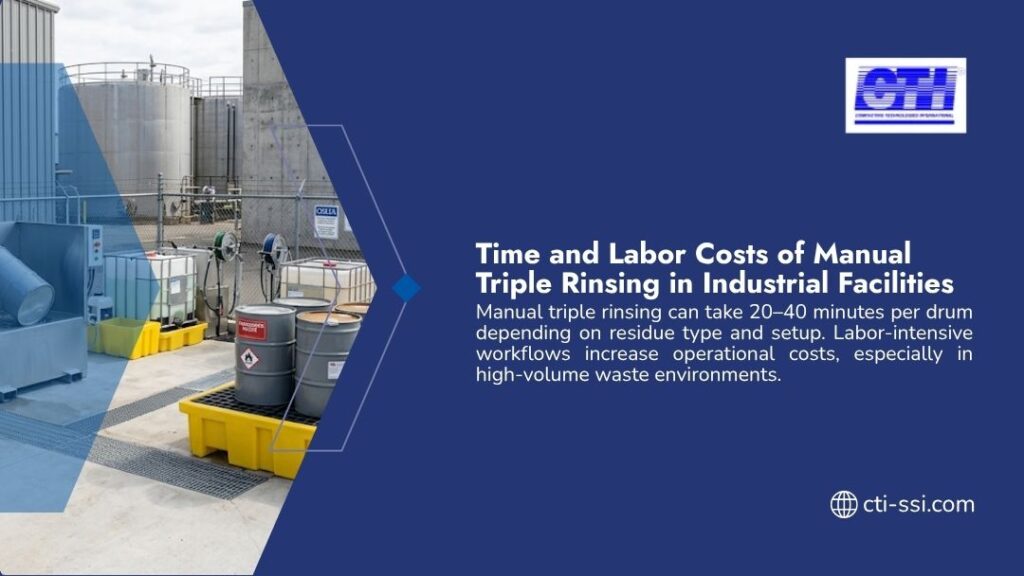
For facilities where workers conduct the rinse procedure manually at a drum station, drum handling safety protocols should be reviewed alongside the rinse SOP to address transfer spill risks and proper drum placement.
Alternatives and Equivalent Methods
The federal rule at 40 CFR 261.7(b)(3)(ii) allows for equivalent cleaning methods in place of the standard triple rinse hazardous waste drums process, provided the method is documented in peer-reviewed scientific literature or verified through generator-conducted tests that demonstrate equivalent residue removal.
Two alternatives are commonly evaluated in industrial practice:
- Pressure rinse.
A high-pressure water or solvent jet applied to all interior surfaces. This can achieve equivalent or superior residue removal in fewer cycles if properly documented.
Specialized equipment and a written verification test are required before the EPA will accept it as equivalent.
- Mechanical agitation.
Drum rotator or tumbler systems that automate the agitate-and-drain cycle, widely used in high-volume drum programs with appropriate documentation in place.
| Method | Effectiveness | Regulatory Acceptance | Cost Factor |
| Triple rinse (manual) | Standard compliance | Explicit in 40 CFR 261.7 | Low equipment cost |
| Pressure rinse | High, if documented | Equivalent method clause | Moderate cost |
| Mechanical agitation | High in volume contexts | Requires documented verification | Higher capital cost |
The generator bears the full burden of proof if the EPA questions whether an alternative achieved equivalent removal at the time of inspection.
Best Practices for Industrial Facilities
Facilities with recurring acute hazardous waste drum programs benefit from a standardized approach. Ad hoc procedures create documentation gaps and audit vulnerabilities that are straightforward to prevent with proper program design.
Key recommendations for EHS and facility teams:
- Establish a written SOP for triple rinse hazardous waste drums specific to your waste types and drum sizes
- Pre-select and stock the correct solvents before drum accumulation begins
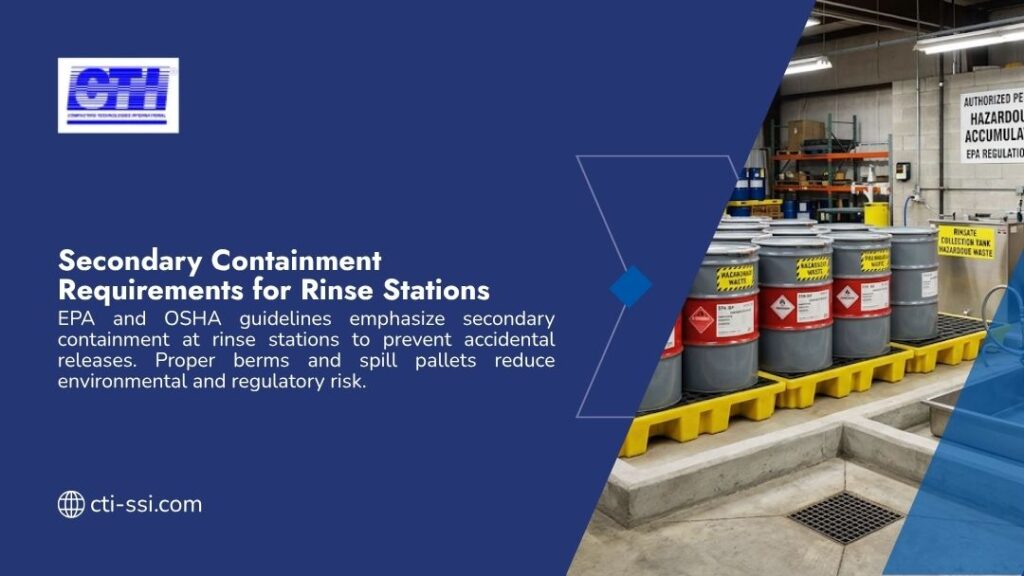
- Designate a fixed rinse station with appropriate rinsate collection capacity and secondary containment
- Maintain a log for every drum processed, with cycle count, solvent used, and responsible personnel
- Conduct periodic internal audits against 40 CFR 261.7 to verify procedure adherence and documentation quality
| Best Practice | Purpose | Recommended Frequency |
| Written SOP | Consistency and audit readiness | Establish once, review annually |
| Solvent inventory check | Correct chemistry on hand | Before each drum campaign |
| Rinse log | Documentation trail per drum | Per drum processed |
| Internal audit | Gap identification | Quarterly minimum |
For facilities that also store drums on-site throughout the accumulation period, osha drum storage requirements should be reviewed in parallel with your rinse SOP to confirm that secondary containment, separation distances, and labeling obligations are met at every stage.
Facilities with high drum volumes can also reduce overall compliance exposure through waste compaction. Fewer active drums in storage means a smaller containment footprint and fewer container-related procedural obligations across the full waste cycle.
Frequently Asked Questions
What does “triple rinse” mean for hazardous waste drums?
Triple rinse hazardous waste drums refers to a three-cycle decontamination process under 40 CFR 261.7(b)(3) for containers that held acute hazardous waste.
Each cycle involves solvent addition, drum agitation to contact all interior surfaces, and complete rinsate drainage into a separate, labeled collection container.
When is triple rinse required under EPA hazardous waste regulations?
Triple rinse hazardous waste drums are required for P-listed acute hazardous waste containers and F-listed waste containers designated with the “H” hazard code. It is not federally required for non-acute listed or characteristic hazardous waste containers, though state programs may add requirements.
How do you properly triple rinse a hazardous waste drum step by step?
The procedure requires three complete fill-agitate-drain cycles with a solvent matched to the original waste residue. Full drainage is required between cycles.
All rinsate must be collected and managed as acutely hazardous waste, with complete written documentation maintained per drum.
What type of solvent should be used for different waste types?
Water is appropriate for water-soluble residues. Organic solvents such as acetone or isopropanol are required for solvent-based residues where the chemistry permits.
The solvent must be capable of removing the specific residue. Always consult the waste profile and safety data sheet before solvent selection.
How should rinsate be handled after the triple rinse?
Rinsate from a triple rinse hazardous waste drums process is classified as acutely hazardous waste under the mixture rule at 40 CFR 261.3.
It must be stored in a compliant accumulation area and disposed of through a licensed transporter and TSDF under an EPA uniform hazardous waste manifest.
Reduce Drum Volume. Reduce Compliance Exposure.
Correct execution of the triple rinse hazardous waste drums process closes one critical part of the compliance loop. For facilities with high drum turnover, the volume of active containers remains a direct driver of cost, storage obligation, and audit risk.
CTI Safety Storage designs and manufactures industrial waste compactors for hazardous, low-level radioactive, and specialized solid waste streams. Each system is built for compliance-sensitive applications:
- HEPA filtration rated at 99.97% efficiency at 0.3 microns for particulate-laden waste streams
- NEMA 7 explosion-proof components for classified hazardous environments
- Stainless steel platens and chambers for corrosive or radioactive decontamination applications
- Liquid removal systems rated for solvent and chemical residues
With compaction of waste volume before disposal, CTI clients reduce the total number of drums through the full waste cycle, which lowers transport, storage, and treatment costs at every stage.Contact CTI Safety Storage to discuss a compaction solution matched to your waste stream, facility layout, and compliance requirements.