Article Summary:
- Industrial facilities spend $150-$400 per hazardous drum on average for disposal
- Poor segregation and classification errors add 15-30% to total disposal costs
- Volume reduction through compaction can decrease disposal expenses by 40-60%
- Violating hazardous waste classification requirements can trigger EPA civil penalties ranging from a few thousand dollars to tens of thousands of dollars
- Contract optimization and bulk scheduling reduce transport fees by 10-20%
This guide explains how to reduce drum disposal costs for industrial facilities that handle hazardous and chemical waste. It covers cost drivers, practical reduction strategies, compliance considerations, and ROI measurement for waste management programs.
Drum Disposal Costs
Drum disposal represents one of the largest recurring expenses for manufacturing plants, laboratories, and industrial facilities. Most operations don’t realize how much money leaves through their waste streams until they examine the numbers closely.
The EPA estimates that U.S. facilities generate over 35 million tons of hazardous waste annually. A significant portion moves through 55-gallon drums that require specialized handling and disposal.
Disposal costs break down into several components. Transport fees account for 25-35% of total expenses. Disposal facility charges make up 40-50%. Labor, storage, and documentation add another 15-25%.
Each component offers opportunities to reduce drum disposal costs when approached systematically.
| Cost Component | Percentage of Total | Average Cost per Drum | Reduction Opportunity |
| Disposal facility fees | 40-50% | $60-$200 | Waste classification, volume reduction |
| Transportation | 25-35% | $40-$140 | Bulk scheduling, route optimization |
| Labor and handling | 10-15% | $15-$60 | Process efficiency, training |
| Storage and documentation | 10-15% | $15-$60 | System improvements, compliance |
Key Cost Drivers for Drum Disposal
Several factors determine final disposal costs. Waste classification creates the biggest impact. Hazardous waste drums cost 3-5 times more than non-hazardous drums to dispose of properly.
Distance to disposal facilities affects transport charges. Facilities located over 200 miles from licensed treatment centers pay premium rates. Volume matters too. Small quantity generators pay per-drum rates while large generators negotiate bulk pricing.
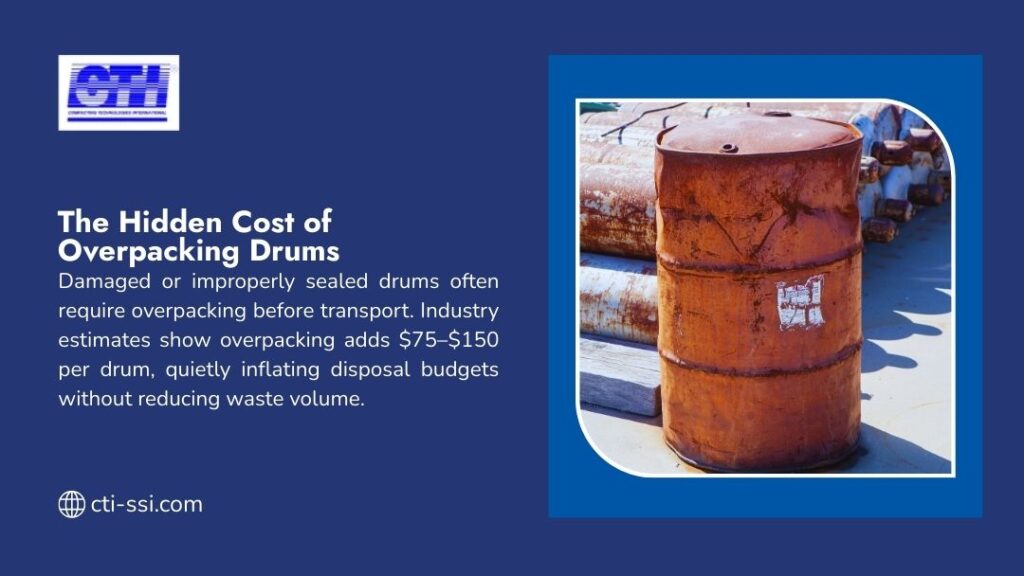
Drum condition influences costs. Damaged or leaking containers require overpacking before transport. This doubles handling expenses and adds $75-$150 per drum. Clean, properly labeled drums move through the system faster and cheaper.
From an operations perspective, facilities that generate 50+ drums monthly should track these cost drivers separately. This data reveals which factors drive expenses and where reduction efforts create the most value.
Common Mistakes That Increase Costs
Poor waste segregation ranks as the most expensive mistake facilities make. Mixing non-hazardous materials with hazardous waste forces the entire batch into costly hazardous disposal streams.
The EPA reports that improper waste classification accounts for a significant portion of RCRA violations.
These penalties come on top of disposal costs already paid.
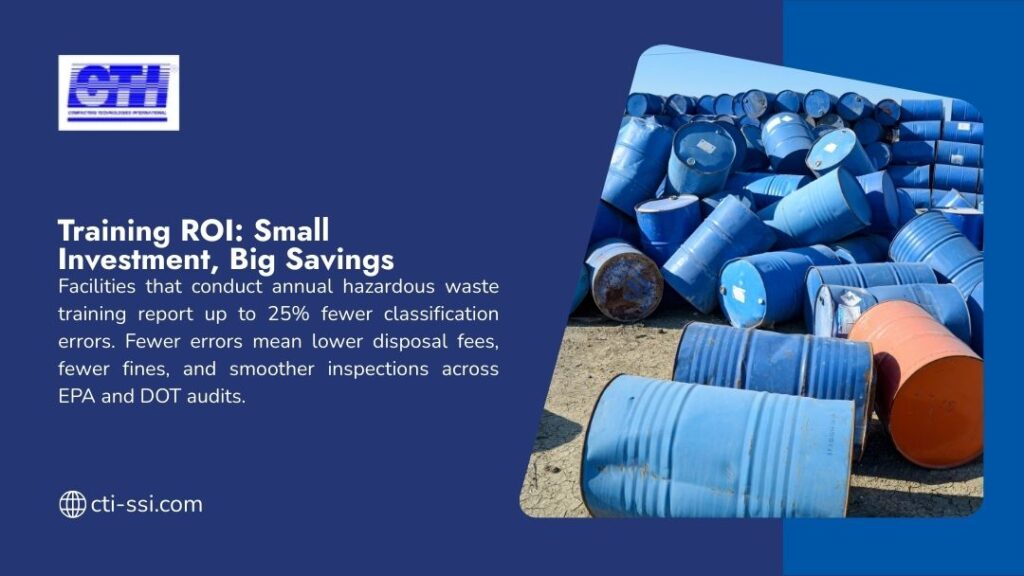
Inadequate staff training creates problems too. Workers who don’t understand RCRA empty container requirements might dispose of drums that could be reused or recycled.
This wastes money on unnecessary disposal and missed revenue opportunities.
Waiting too long between pickups fills storage areas and creates safety hazards. Facilities then pay for emergency collection services at 50-100% premium rates.
Regular scheduling prevents these expensive rush charges.
| Common Mistake | Cost Impact | Prevention Strategy |
| Mixing waste streams | +200-300% disposal costs | Segregation training, separate containers |
| Misclassification | $2,500-$25,000 fines | Staff education, waste characterization |
| Poor labeling | +15-25% handling fees | Standard procedures, quality checks |
| Irregular scheduling | +50-100% emergency fees | Planned pickup calendar |
4 Practical Strategies to Reduce Drum Disposal Costs
Small changes in waste handling processes create substantial savings. Facilities that implement systematic improvements typically cut disposal expenses by 20-40% in the first year.
These strategies don’t require major capital investment. Most involve process adjustments and better management of existing operations.
The key is taking a structured approach rather than making random changes.
- Segregation and Classification of Drums
Proper waste segregation stops facilities from paying hazardous disposal rates for non-hazardous materials. This single practice delivers the fastest return on effort.
Start by identifying waste streams at generation points. Set up separate collection containers for hazardous and non-hazardous materials. Label each container clearly with waste type and hazard class.
Train staff to recognize which materials belong in each stream. Provide quick reference guides at collection points. Make the right choice, the easy choice through clear systems.
According to waste management industry data, facilities that implement rigorous segregation programs reduce overall disposal costs by 15%.
The savings come from routing materials to appropriate disposal pathways rather than treating everything as hazardous waste.
| Waste Classification | Disposal Cost Range | Annual Savings (100 drums) |
| Hazardous (D-list, F-list) | $150-$400 per drum | Baseline |
| Non-hazardous industrial | $50-$120 per drum | $10,000-$28,000 |
| Recyclable/reusable | $0-$50 per drum | $15,000-$40,000 |
Documentation matters as much as physical segregation. Keep waste characterization records that prove classification decisions. These records protect against enforcement actions and support disposal cost tracking.
- Volume Reduction Techniques
Compaction offers the most direct path to lower disposal costs. Reducing waste volume cuts the number of drums that need disposal and transport.
Industrial drum compactors can achieve 3:1 to 5:1 volume reduction ratios. This means three to five drums of waste compress into one drum for disposal.
The math works out to 40-60% savings on disposal and transport fees.
Safety matters when compacting drums. Equipment needs proper controls for hazardous materials. NEMA 7 explosion-proof systems prevent ignition in areas with flammable vapors. Liquid removal systems extract fluids before compaction to prevent spills.
From an engineering perspective, facilities should evaluate compaction when they generate 20+ drums monthly. The equipment investment pays back through disposal savings within 12-24 months for most operations.
Drum crushing serves specific applications where volume reduction takes priority over material recovery. Steel drum crushing equipment flattens empty containers to 10-15% of original volume.
This works well for hazardous waste barrels that cannot be reused.
| Volume Reduction Method | Reduction Ratio | Equipment Cost | Best Application |
| Manual compaction | 2:1 | $500-$2,000 | Very low volumes |
| Hydraulic drum compactor | 3:1 to 5:1 | $15,000-$45,000 | Regular generation |
| Industrial crushing system | 8:1 to 10:1 | $25,000-$75,000 | High-volume facilities |
Liquid removal systems work alongside compaction. These systems extract fluids from solid waste before compression. The separated liquids route to appropriate liquid waste removal processes while solids compact more efficiently.
CTI Safety Storage manufactures compaction systems designed for hazardous and radioactive waste applications. Their equipment features liquid removal capabilities and HEPA filtration systems that capture particulates during compression.
- Reuse, Recycling, and Alternative Disposal
Many drums classified for disposal could be reconditioned and reused. Steel drums in good condition have value to drum reconditioners who clean and resell them.
Reconditioners pay $5-$15 per empty steel drum depending on condition and local market. This turns a disposal cost into a small revenue stream. The key is keeping drums clean and free from contamination that prevents reconditioning.
Plastic drums present different opportunities. While harder to recondition, many can be recycled if properly cleaned. Facilities should research local recycling options for HDPE drums used with compatible materials.
The EPA allows drum reuse under specific conditions. Containers must be emptied using methods that remove all materials possible.
They need labeling that identifies previous contents. Facilities must verify compatibility between old and new contents.
According to RCRA regulations, properly emptied containers may not classify as hazardous waste. This creates significant savings when drums can be reused internally rather than sent for disposal.
Understanding these requirements helps facilities maximize reuse opportunities.
| Reuse/Recycle Option | Revenue/Savings per Drum | Requirements |
| Steel drum reconditioning | $5-$15 revenue | Good condition, empty per RCRA |
| Plastic drum recycling | $2-$8 revenue | Clean, compatible materials only |
| Internal reuse (same material) | $50-$120 savings | RCRA empty, proper labeling |
| Internal reuse (compatible material) | $50-$120 savings | Compatibility verification required |
Some waste materials have markets that pay for specific streams. Spent solvents, certain oils, and some metal-bearing wastes have buyers who process them for recovery.
Research local markets for any waste streams generated regularly.
- Optimizing Disposal Contracts
Many facilities accept the first disposal quote without comparison shopping. This leaves money on the table that competitive bidding could capture.
Request quotes from at least three licensed disposal companies annually. Provide detailed information about waste types, volumes, and generation frequency.
This allows accurate bids rather than high estimates that pad contractor margins.
Bulk scheduling reduces per-drum costs. Instead of calling for pickup when storage fills, establish a regular schedule. Monthly or quarterly pickups cost less than on-demand service because contractors can route efficiently.
Contract terms matter beyond just pricing. Look for agreements that include documentation services, emergency response capabilities, and regulatory support.
Volume commitments sometimes unlock better pricing. Facilities that can guarantee minimum annual volumes negotiate discounts of 10-20% below standard rates.
This works best for operations with predictable waste generation.
| Contract Optimization | Typical Savings | Implementation Effort |
| Competitive bidding | 15-25% | Medium (annual RFP process) |
| Scheduled vs on-demand | 10-15% | Low (set regular pickups) |
| Multi-year agreements | 5-10% | Low (negotiate longer terms) |
| Volume commitments | 10-20% | Low (forecast annual volumes) |
Compliance Considerations and Risk Management
Cost savings mean nothing if they create regulatory violations. Every strategy to reduce drum disposal costs must maintain full compliance with EPA, OSHA, and DOT requirements.
The Resource Conservation and Recovery Act (RCRA) establishes baseline requirements for hazardous waste management. Facilities must follow these rules regardless of cost pressures.
Generator classification determines many requirements. Small quantity generators (100-1,000 kg monthly) face different rules than large quantity generators (over 1,000 kg monthly). Know which category applies to your facility and follow corresponding requirements.
Documentation protects facilities from liability. Keep manifests for all hazardous waste shipments. Maintain waste characterization records. Store training documentation for staff who handle waste.
The EPA requires three years minimum retention but many states mandate longer periods.
Proper labeling prevents costly mistakes. Each drum needs clear identification of contents, hazard class, and accumulation start date. Missing or incorrect labels create violations during inspections and cause handling delays that cost money.
| Compliance Requirement | Violation Penalty | Cost-Effective Compliance |
| Proper waste characterization | $2,500-$25,000 | Annual testing, staff training |
| Manifest system | $2,500-$10,000 | Digital tracking, document retention |
| Container labeling | $1,000-$5,000 | Standard procedures, quality audits |
| Storage time limits | $5,000-$25,000 | Scheduled pickups, inventory tracking |
Safety considerations affect costs too. OSHA requires training for workers who handle hazardous materials. Facilities need appropriate PPE, emergency equipment, and spill response supplies.
Insurance companies review waste management practices during underwriting. Poor practices increase premiums or limit coverage.
When implementing strategies to reduce drum disposal costs, verify each approach meets regulatory requirements first. Savings that create violations cost more than they save once penalties and remediation factor in.

Frequently Asked Questions About How to Reduce Drum Disposal Costs
What are typical disposal costs per 55-gallon drum?
Non-hazardous drums cost $50-$120 for disposal and transport and hazardous waste drums run $150-$400 depending on classification. Highly regulated wastes like radioactive materials cost significantly more.
Can hazardous waste drums be compacted safely and legally?
Yes, when proper equipment and procedures are in place. Compactors designed for hazardous waste include safety features like explosion-proof controls, liquid removal systems, and HEPA filtration.
How much can drum compaction reduce disposal fees?
Compaction typically reduces disposal costs by 40-60% through volume reduction. A facility that generates 100 drums monthly might compress them into 30-40 drums. This cuts disposal fees, transport charges, and storage needs proportionally.
What equipment options exist for drum volume reduction?
Manual compactors work for very low volumes at $500-$2,000. Hydraulic drum compactors handle regular generation with 3:1 to 5:1 reduction at $15,000-$45,000. Industrial crushing systems achieve 8:1 to 10:1 reduction for high-volume operations at $25,000-$75,000.
How do recycling and reuse options affect total disposal costs?
Reusing drums eliminates disposal costs entirely. Reconditioning companies pay $5-$15 for empty steel drums in good condition. Internal reuse saves $50-$120 per drum compared to disposal and new drum purchase.
What compliance steps prevent costly misclassification fines?
To prevent costly misclassification fines, facilities should properly characterize all waste streams to determine their correct RCRA hazard classification, train staff on classification and labeling requirements, and document every classification decision with supporting data.
Final Considerations
Facilities that understand how to reduce drum disposal costs protect budgets while maintaining safety and compliance. The strategies outlined here work across industries from manufacturing to research to healthcare.
Important steps include:
- Proper waste segregation at generation points,
- Volume reduction through appropriate compaction systems,
- Evaluation of reuse and recycling opportunities,
- Contract optimization through competitive bidding,
- Rigorous compliance with all applicable regulations.
Start with the lowest-cost improvements first. Better segregation and staff training require minimal investment but deliver immediate results. Use those savings to fund equipment purchases that create long-term cost reductions.
Track results monthly to verify that improvements work as planned. Share savings data with management to maintain support for waste reduction programs. The facilities that treat waste management as an ongoing optimization process see the best long-term results.
Disposal costs represent money leaving the facility with zero value received. Every dollar saved through better waste management drops directly to the bottom line.
In competitive industries where margins matter, waste reduction creates a measurable financial advantage.