Article Summary
- Secondary containment for drums is a federal compliance requirement under EPA and OSHA
- Containment capacity must equal the largest single container volume or 10% of total stored volume
- Multiple drums can share one containment system when capacity rules are satisfied
- Outdoor storage requires additional volume to account for precipitation accumulation
- Common violations include undersized containment, chemical incompatibility, and absent inspection schedules
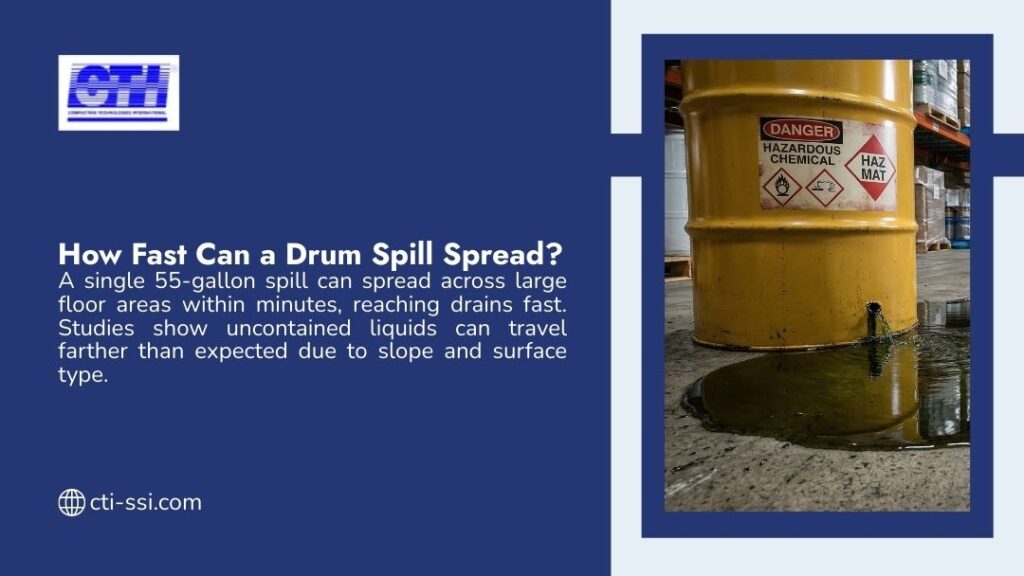
A single 55-gallon drum failure can contaminate thousands of gallons of groundwater and trigger federal penalties up to $37,500 per day.
For EHS managers, facility directors, and compliance officers, secondary containment requirements for drums are not voluntary guidelines. They are enforceable federal standards with direct environmental and financial consequences.
This article clarifies what secondary containment for drums means in practice, which regulations apply, how to calculate the correct capacity, which systems qualify as compliant, and the compliance mistakes that most frequently result in violations.
What Is Secondary Containment for Drums?
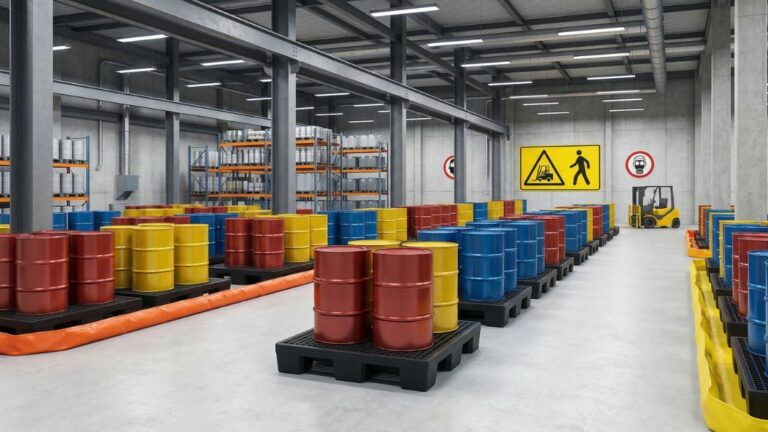
Secondary containment is a physical barrier system placed outside the primary container (the drum itself) to capture any liquid that escapes from a leak, rupture, or transfer spill.
It functions as the last line of defense before a chemical release reaches the floor, a drain, or the broader environment.
A properly sized system also shields workers from direct chemical contact, reduces facility liability, and keeps the operation within the boundaries of federal storage standards.
| Containment Type | Purpose | Examples |
| Primary containment | Holds the chemical directly | Drum, tank, IBC tote |
| Secondary containment | Captures leaks or spills | Spill pallet, berm, concrete dike |
Secondary containment captures releases from four primary failure points:
- Corroded or physically damaged drum walls
- Overfilled containers with no available headspace
- Transfer spills at fittings, valves, or pump connections
- Structural failures at the drum base or seam
Facilities that store RCRA hazardous waste must integrate secondary containment into their broader waste storage compliance program. The specific chemicals on-site and their total volume determine which regulatory standards apply.
Why Secondary Containment Is Required
Three distinct regulatory frameworks drive secondary containment requirements for drums across U.S. industrial facilities. Each addresses a different exposure risk and applies to different facility profiles.
The EPA’s Spill Prevention, Control, and Countermeasure (SPCC) rule applies to facilities with oil storage above defined threshold volumes.
OSHA’s Hazardous Materials Storage standard (29 CFR 1910.120) sets worker protection requirements wherever hazardous substances are present.
The EPA’s Resource Conservation and Recovery Act (RCRA) governs hazardous waste from initial generation through final disposal.
| Regulation | Agency | What It Covers |
| SPCC Rule | EPA | Oil spill prevention for qualifying facilities |
| Hazardous Waste Regulations | EPA / RCRA | Waste storage and containment |
| Hazardous Material Storage | OSHA | Worker safety standards |
The compliance goal across all three frameworks is identical: prevent hazardous materials from reaching soil, stormwater infrastructure, groundwater, or active work areas.
Facilities that hold partially used drums should also review RCRA empty container requirements, since residue-containing drums remain subject to containment rules until they satisfy federal empty container criteria.
Secondary Containment Requirements for Drums: Capacity Rules Explained
Two Rules That Set Minimum Containment Capacity
Two capacity rules appear most frequently in EPA and state guidance for secondary containment requirements for drums: the largest container rule and the 10% rule. Both are calibrated to ensure a containment system can absorb a realistic worst-case release.
The largest container rule requires the secondary containment system to hold at least the full volume of the single largest drum in the area. For a standard 55-gallon drum, that minimum threshold is 55 gallons.
The 10% rule requires containment to hold at least 10% of the combined volume of all drums in the storage area.
| Rule | Explanation |
| Largest container rule | Containment must hold at least the volume of the largest single drum |
| 10% rule | Containment must hold 10% of total combined drum volume |
The binding requirement is whichever value is greater. At low drum counts, the largest container rule typically controls. As drum totals rise, the 10% calculation overtakes it and sets the minimum.
Familiarity with [hazardous waste examples] at your facility also helps identify which drums require containment and which regulatory tier applies.
How to Calculate Secondary Containment for Multiple Drums
The capacity calculation follows a consistent five-step process. Apply it to each storage area separately, not across the full facility as a single unit.
- Count all drums in the specific storage area
- Multiply drum count by individual volume (55 gallons per standard drum)
- Calculate 10% of that combined total
- Identify the volume of the single largest drum in the area
- Use the greater value as the required minimum containment capacity
| Number of Drums | Total Volume | 10% Volume | Required Containment |
| 4 drums | 220 gallons | 22 gallons | 55 gallons |
| 8 drums | 440 gallons | 44 gallons | 55 gallons |
| 12 drums | 660 gallons | 66 gallons | 66 gallons |
At 12 drums, the 10% rule (66 gallons) exceeds the largest container rule (55 gallons) and becomes the binding minimum. This crossover is where undersized containment most often appears in compliance audits.
The characteristics of hazardous waste present in your drums also determine what material the containment system must be constructed from, not only its volume.
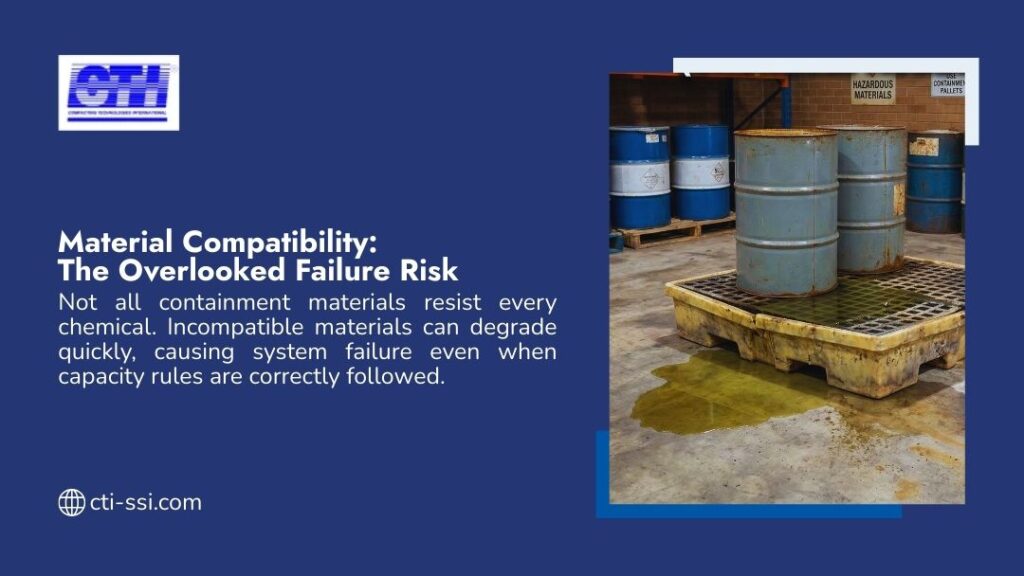
Types of Secondary Containment Systems for Drums
Not every containment solution meets regulatory expectations.
The five most common systems found in drum storage facilities are:
- Spill pallets: Portable grated platforms with an integrated sump beneath. Best suited for small drum counts in fixed indoor areas.
- Containment berms: Flexible or rigid perimeter barriers that surround a full storage zone. Practical for temporary setups or areas with irregular drum layouts.
- Diked concrete areas: Permanent structures with raised perimeter walls. The standard for large, fixed drum storage.
- Drum containment platforms: Flat raised platforms with a lip perimeter, suited for individual drums or small groups.
- Sumps and sealed drainage systems: Built-in floor collection points used within dedicated chemical storage rooms.
| System Type | Best For | Key Advantage |
| Spill pallets | Small indoor drum storage | Portable, easy to reposition |
| Containment berms | Temporary or outdoor use | Flexible configuration |
| Concrete dikes | Large fixed storage areas | High capacity, permanent |
System selection depends on four factors: chemical compatibility between the containment material and stored substance, total volume to be held, indoor versus outdoor placement, and whether mobility is a facility requirement.
A review of types of hazardous waste present at your facility will clarify which containment materials can safely contact the chemicals stored within.
Secondary Containment for Outdoor Drum Storage
Outdoor drum storage introduces hazards that indoor environments do not present. Rainfall accumulation is the primary variable, as precipitation that collects inside a containment system reduces available capacity and can cause overflow before any drum failure occurs.
EPA guidance under the SPCC rule requires that outdoor containment volume account for the precipitation a region receives during a design storm event.
Facilities in high-precipitation zones often need significantly more capacity than the standard spill containment requirements for drums alone would produce.
| Risk | Containment Solution |
| Rainwater accumulation | Covered containment or expanded capacity |
| Overflow risk | System sized for precipitation volume plus drum volume |
| Contaminated runoff | Sealed systems with no open floor drains |
Four additional requirements for compliant outdoor drum storage:
- Drain accumulated rainwater before it displaces available containment capacity
- Inspect containment integrity after major weather events and seasonal temperature shifts
- Prevent stormwater from entry into sealed containment zones
- Verify that outdoor berms and pallets carry UV resistance and weather-rated certification
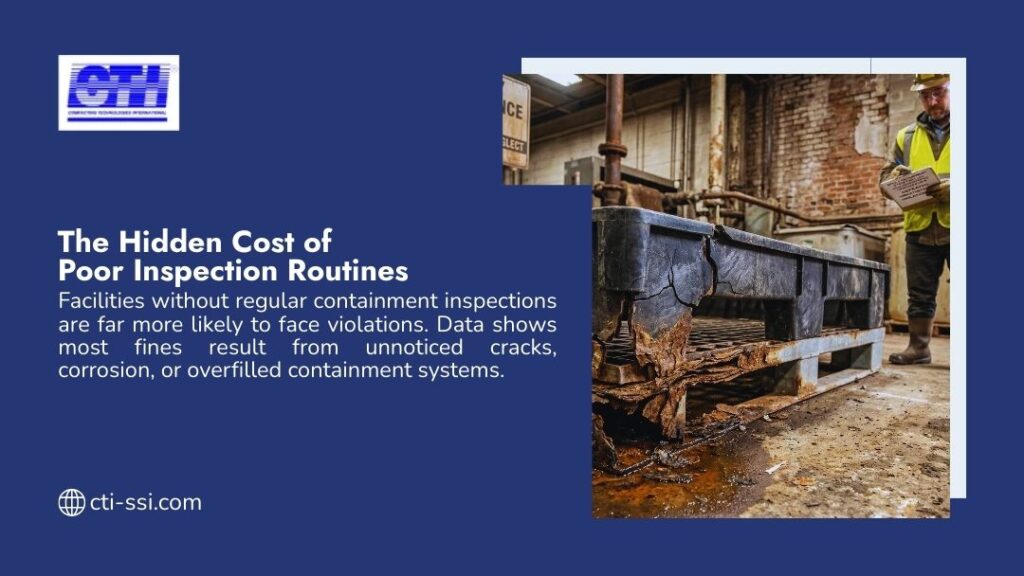
Common Compliance Mistakes Facilities Make
Violations in drum secondary containment follow predictable patterns. The most frequent issues identified during EPA and OSHA inspections include:
- Containment systems sized below the required minimum capacity
- Pallets or berms constructed from materials that react with stored chemicals
- No routine inspection schedule, so containment failures go undetected until a release occurs
- Blocked or corroded drainage connections inside containment areas
- Containment units used past rated capacity, with no available sump space left
| Mistake | Risk |
| Insufficient containment capacity | Environmental contamination, regulatory penalty |
| Incompatible containment materials | Failure at direct chemical contact |
| Absent inspection routine | Undetected spills reach soil or groundwater |
Civil penalties under RCRA for improper hazardous waste storage can reach $37,500 per day per violation. SPCC rule violations carry comparable civil penalty structures for oil-related releases.
Drum handling safety practices should be reviewed alongside containment standards. Improper drum placement, stacking, and transfer procedures are a direct cause of preventable spills, regardless of the capacity built into the containment system.
FAQs on Secondary Containment Requirements for Drums
What are the OSHA and EPA secondary containment requirements for drums?
OSHA requires secondary containment for hazardous materials under 29 CFR 1910.120. EPA requirements fall under RCRA for hazardous waste storage and the SPCC rule for oil storage above threshold quantities. The combined framework requires a physical barrier system capable of capturing a full drum release without discharge to soil or stormwater.
How much capacity must secondary containment hold for 55-gallon drums?
Containment must hold either the full volume of the largest single drum (55 gallons minimum) or 10% of the total stored volume — whichever is greater. For 12 or more standard 55-gallon drums, the 10% rule overtakes the largest container rule and sets the required minimum.
Can multiple drums share one secondary containment system?
Yes. A single containment system can hold multiple drums provided total capacity meets the applicable rule. The containment material must also be chemically compatible with every substance stored within the shared system.
Is secondary containment required for all hazardous materials?
Federal requirements apply to hazardous waste under RCRA and to oil above SPCC thresholds. State environmental regulations frequently extend requirements further. Materials that fall outside federal hazardous classification may still require containment under applicable state law.
What types of containment systems are acceptable for drum storage?
Spill pallets, containment berms, concrete dike structures, drum platforms, and sealed sumps all qualify as compliant systems when correctly sized, chemically compatible with stored substances, and kept in good physical condition. Each system must hold the required volume without leakage or structural failure.
Conclusion
Secondary containment requirements for drums exist because a single uncontrolled release — (from one corroded drum or one transfer spill) can contaminate groundwater in hours and generate federal penalties that accumulate daily until the violation is resolved.
Correct capacity calculation, chemically compatible containment materials, and a consistent inspection routine form the three-part foundation of a compliant drum storage program.
For facilities that also want to reduce their active drum count and lower the overall containment footprint required, How to reduce drum disposal costs covers practical reduction approaches worth reviewing.
Ready to Reduce Drum Volume and Storage Demand?
CTI Safety Storage designs and manufactures industrial compaction systems built for hazardous, low-level radioactive, and specialized solid waste.
With optional HEPA filtration rated to 99.97% at 0.3 microns, NEMA 7 explosion-proof components, and stainless steel decontamination chambers, CTI compactors meet the safety and compliance standards demanded by aerospace facilities.
Contact CTI Safety Storage to request a compaction solution matched to your waste stream, storage requirements, and compliance obligations.